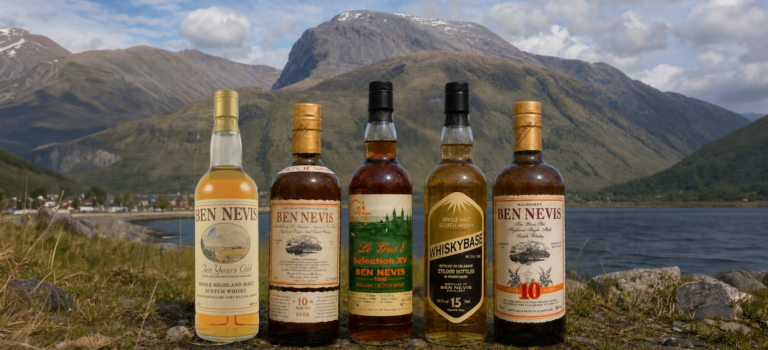
FIve Ben Nevis

Ben Nevis 2010 Whiskybase And More

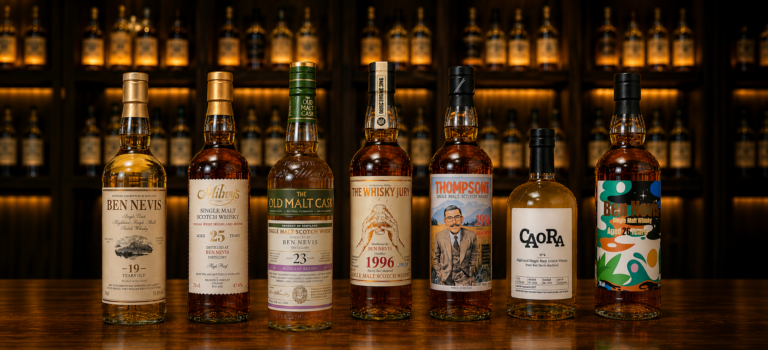
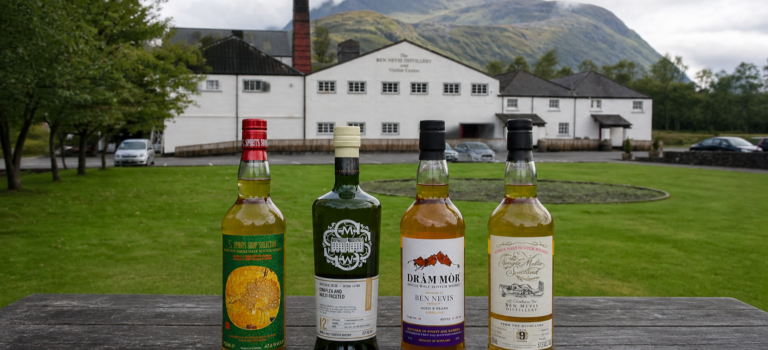
Time for a Ben Nevis session, beginning with the recent 2010 single cask bottled by Whiskybase to mark the 270,000th bottle recorded in its database. It is a 15-year-old release bottled at 54.2% ABV. It will be joined by a small selection of other Ben Nevis bottlings: an official 10-year-old from 2000; two further official 10-year-olds bottled in 2018, including the cask-strength Batch 1; and a 27-year-old release from Le Gus’t, also bottled in 2018.

Read more
Blends from old times part 4

Blends From Old Times Part 4

We continue our series on older blends with three more bottlings: a James Martin’s V.V.O. from the 1970s, a Clan Campbell from the early 1960s, and a Langside bottled in the late 1960s or early 1970s. If you have not yet read part one, part two or part three, you can find them through their respective links. Now, let’s see how this new trio performs!

Read more
Three blends from old times

Blends from Old Times Part 3

After a short break in Wick, we’re back to the series on older blends – following part one and part two – with three more bottles from past decades. Today’s lineup includes two blends from the 1960s: Passport and House of Lords, followed by a more recent Talisman, bottled sometime in the 1990s or early 2000s.

Read more
Old Pulteney Distillery Exclusive and 1990 Travel Retail

Old Pulteney Distillery Exclusive and 26-Year-Old

We take a quick break from the blends from old times (part 1 and part 2 are here if you haven’t read them yet), because it’s been two years already since our first and last Old Pulteney review, and I have a promising pair in my sample drawers. So let’s do some catch-up with an Old Pulteney Distillery Exclusive from a couple of years ago, and a 26-year-old released at first for Travel Retail.

Read more
Three blends from older times: Cluny & C&J McDonald's

Blends From Old Times Part 2: Cluny and C&J

We continue our exploration of older blends, this time with three bottlings from the 1960s and 1970s: two Cluny releases and a C&J McDonald’s. The Cluny pair consists of a no-age-statement bottling from the 1960s and a five-year-old from the 1970s, followed by a C&J blend from the same decade. Let’s see how they compare.

Read more
Three blends from old times

Blends From Old Times Part 1

Today marks the beginning of a short series exploring blended Scotch from an earlier era. By ‘earlier’, I mean bottlings from roughly the 1960s through to the 2000s, although the main focus will be on the 1960s and 1970s.

We begin with three blends: Teacher’s Highland Cream, which has (kind of) appeared on the blog before; VAT 69, the long-established William Sanderson blend first created in 1882; and Cameron’s Black Prince, a name that was entirely new to me. Teacher’s and VAT 69 were major historic brands with distinctive identities, while Black Prince offers a more obscure point of comparison.

The aim of this review, and of however many follow, is not simply to indulge in nostalgia. Instead, it is to look at these older bottlings on their own terms and consider the familiar question: was whisky really better in the past?

Read more
Four Macallan 12 and Speymalt 20

Four Macallan 12 yo and a 20 yo Speymalt

Macallan has so far been something of a blind spot on More Drams Less Drama. We have only reviewed a pair of secret Macallans – both bottled by Le Gus’t – and they were, frankly, stunning. This time, however, there is no need for concealment: we are heading directly into one of Speyside’s most recognisable names, through four versions of the Macallan 12-Year-Old Sherry Oak Cask and a mature 2000 Speymalt from Gordon & MacPhail.

The four 12-year-olds should make for a particularly useful exercise in comparison. A whisky with such a fixed identity on paper can still evolve through changing cask sourcing, batch composition, bottling eras and the inevitable small adjustments of a long-lived official range. Adding Gordon & MacPhail’s 20-year-old Speymalt 2000 offers a different perspective altogether: a longer-aged, independently bottled Macallan, selected and presented beyond the official Sherry Oak framework. Together, they should tell us something about consistency, evolution, and the many ways Macallan’s sherried spirit can be interpreted.

Read more
Two Bowmore 2005 The Whisky Agency

Two Bowmore 2005 The Whisky Agency

Back in February we were stunned by a few magnificent official Bowmore, so this time I’m turning to two independent bottlings. Rather fittingly, they are sister casks released by the same bottler and retailer, The Whisky Agency: both were distilled in 2005, matured in the same type of cask and bottled in 2026. The question, then, is whether these two Bowmore prove closely aligned in character or reveal meaningful differences between casks.

Read more
Four Springbank 15-year-old

4 Springbank 15-year-old and Batch Variation

After our Irish detour, we are back in Scotland, and more specifically in one of the country’s most obsessively followed distilleries: Springbank. This tasting brings together four 15-year-olds – an older bottle from 2006 and the 2024, 2025 and 2026 releases – for a simple but revealing exercise in batch variation, with the aim of seeing how much the same age statement can shift over time while still remaining recognisably Springbank.

That kind of comparison is exactly where Springbank tends to reward attention. Even when the age statement stays fixed, the cask mix, batch composition and bottling conditions can subtly reshape the whisky from one release to the next, so lining up an older bottling against three recent ones should tell us a lot about continuity and drift, and perhaps even about what we really mean when we say a whisky is ‘the same’ from year to year. When the Local Barley has age, cask and farm variation, the Springbank 15-year-old shows stability.

Read more
Three Auchroisk: 1975 / Flora and Fauna / Chorlton

Auchroisk 1975 / Flora & Fauna / Chorlton

Auchroisk is one of those Speyside distilleries that most whisky drinkers know indirectly, because much of its spirit has long gone into blends rather than into a broad official single-malt range. That makes a trio like this especially attractive: a rare 1975 bottling from the old “The Singleton” era, the 10-year-old Flora & Fauna, and a 14-year-old independent bottling from Chorlton Whisky all show different faces of the same distillery across different periods and bottling philosophies.

Read more