Another milestone already! After recently reaching 1000 spirits reviewed on More Drams since its creation, I’ve now hit 3000 different whiskies tasted, as far as I can track and remember, thanks to Brian ‘Malt Musings’ excellent whisky spreadsheet. As with any major milestone, the question was what to pour in celebration. I considered some older Balblairs, like the 1966 38-year-old and a 40-year-old bottled by Specialist Drinks, or one of several silent distilleries, such as Lochside, Glen Albyn, Glen Mhor, Dallas Dhu, Pittyvaich, Brora or pre-reopening Port Ellen, but I decided to go in a different direction: whisky from another era. That left plenty of options too, and for this occasion I chose a Jameson Irish whiskey bottled in the late 1930s or early 1940s, even older than the pre-WWII Ballantine’s 30-year-old we tried two years ago. It also needed a sparring partner, and since I recently picked up a few dozen old minis from the 1970s to the 2000s, a Jameson 12-year-old in the bunch gave me the comparison point I needed.
The Whisky Industry in the late 1930s and early 1940s
By the late 1930s, Scotch had already become more commercially powerful than Irish whiskey on the international stage. Irish whiskey still had name recognition and heritage, but the Irish industry was much smaller and more fragile, while Scotch benefited from a larger industrial base, stronger blending houses, and broader export networks. The United States mattered enormously to both, but especially to Scotch: after Prohibition, American consumers were again able to buy imported whisky, and demand for Scotch recovered strongly enough that it became one of the key export markets for the industry.
Europe was a more complicated patchwork. Continental markets were attractive, but they were uneven in regulation, tariffs, and political stability, and the smuggling of alcohol into the United States via Europe was still a real issue in the 1930s, showing how valuable the transatlantic trade had become even before the war fully reshaped it. Irish whiskey, meanwhile, remained prestigious in some circles but lacked the scale and distribution power of Scotch, which increasingly dominated the export conversation.
Once war began in 1939, production and shipping were immediately affected. Scotch distilling was cut back sharply, with wartime restrictions limiting output in order to conserve grain and direct resources toward the war effort, and by 1943 malt whisky distillation had effectively fallen to nil in some accounts. That meant the industry entered the war with a finite pool of mature stock and then largely stopped replenishing it, a decision that protected the future but constrained supply in the present.
Ireland was in a different political position, but it also faced severe disruption. Neutrality did not insulate Irish producers from shortages, export problems, and market contraction, and the industry remained much smaller and more vulnerable than Scotch during the war years. Irish whiskey’s production base was already narrow by this point, so any interruption in demand or distribution had a proportionally larger impact than it did in Scotland.
In Europe, whisky became more of a scarcity item and less of a normal consumer good. Military demand, rationing, transport disruption, and trade controls all reduced availability, while the broader wartime economy forced governments to treat alcohol as a strategic and fiscal commodity rather than a straightforward luxury. Scotch’s stronger industrial base helped it survive, but even there the emphasis shifted toward stock management rather than active market expansion.
For Irish whiskey, the European market in the late 1930s and early 1940s was not a growth engine so much as a fragile outlet that could be lost quickly if shipping or financing became difficult. Scotch, with its blending houses and export experience, was better positioned to hold what remained of the market, even if volumes were constrained.
The U.S. was the prize market, but it was not an easy one. After Prohibition, Scotch re-established itself as the most successful imported whisky, and wartime shortages only increased the premium on any mature stock that could still be exported. The post-war American market would later become the main driver of Scotch’s expansion, but even in the early 1940s the U.S. was already the destination that mattered most for any whisky with export ambitions.
For Irish whiskey, the U.S. was also important culturally, but the industry could not exploit it in the same way. It lacked the volume, the marketing power, and, in many cases, the stock availability to compete with Scotch on equal terms, which is one reason the balance between the two spirits tilted further toward Scotch as the decade progressed.
So the short version is this: by the late 1930s Scotch was already the stronger international business, and by the early 1940s wartime restrictions turned that advantage into sheer resilience. Irish whiskey retained heritage and recognition, but it entered the war from a much weaker industrial position and suffered more from the collapse in trade and the narrowing of its already limited export base. In Europe, both spirits were battered by the war economy; in the United States, Scotch emerged as the more durable and better positioned import, setting up the post-war dominance that would follow.
Jameson Whiskey
Jameson is the best-known Irish whiskey brand in the world, and also the clearest case study of how a once-dominant national spirit can survive collapse, consolidation, and reinvention. It began in 1780 with John Jameson in Dublin, was eventually displaced from its original Bow Street home, and today (since 1975) is produced at Midleton Distillery in County Cork, where it has become the flagship of modern Irish whiskey.
John Jameson founded the brand in Dublin in 1780, at a time when Irish whiskey was still a major international category and Dublin was the centre of its production. The original Bow Street distillery grew into one of the biggest in the city, and Jameson built its identity around triple distillation, a practice that became one of the defining markers of Irish whiskey style.
By the 19th century, Jameson was a leading name in Irish whiskey, but the broader industry then entered a long decline driven by temperance, political upheaval, trade disruption, and competition from Scotch. Prohibition in the United States was especially damaging because it cut off an important export market just as Scotch was gaining ground internationally.
Today Jameson is made at Midleton in County Cork, not in Dublin, and is owned by Irish Distillers, which sits within Pernod Ricard. The brand’s production is built around a blend of triple-distilled pot still whiskey and grain whiskey, with Jameson emphasising a smooth, accessible style rather than heavy oak or peat.
Jameson’s own materials describe a process built on barley, water from the Dungourney River, and grain sourced largely in Ireland, with maize also used in the grain component. Maturation is typically in a mix of ex-bourbon and sherry-seasoned casks, with whiskey aged for at least three years as required by Irish law.
The core Jameson Original remains the best-known expression, but the wider range has expanded significantly over time to include variants such as Black Barrel, Caskmates, Crested, and age-stated or special releases. The brand’s modern success owes a lot to Pernod Ricard’s marketing after its 1988 acquisition, which helped transform Jameson from a heritage name into a global mass-market leader.
That transformation is visible in the numbers: Jameson is now sold in more than 100 countries, and recent accounts describe it as accounting for roughly half of global Irish whiskey sales. In other words, Jameson is not just a brand with history; it is the engine of the modern Irish whiskey category.
Jameson 12-year-old (1980s or 1990s) Review
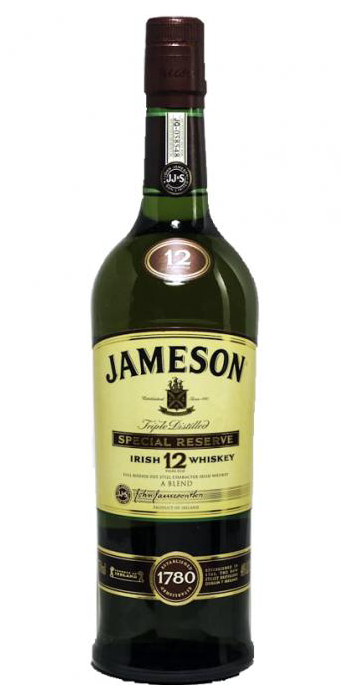
This bottling of Jameson 12-year-old dates from the whiskey’s earliest branded identity as ‘1780’ – a reference to the year the original Jameson distillery on Dublin’s Bow Street was established – first launched in the early-to-mid 1980s as a prestige blend, before being rebranded as ‘Special Reserve’ in 2008 with an unchanged recipe. By the 1980s, Jameson production had already moved from Bow Street to the modern Midleton distillery in County Cork, following the 1975 closure of the original site. Jameson 12 Year Old is a blend of triple-distilled pot still whiskey (historically around 75% of the recipe) with grain whiskey, matured in a combination of bourbon and Oloroso sherry casks, with the pot still component in particular aged up to 17 years despite the 12-year age statement on the label, reflecting the practice of blending in some older stock.
Colour:
Between russet and tawny with a brownish hue.
Nose:
Neat: Sherry-driven with citrus notes – lime, lemon, and orange – and tropical notes – maracuja, mango – running through a soft, mellow sweetness, joined by slight hints of oak and background spice, dried fruit, peach, and delicate malt or barley character. Stewed apples with a wine-like quality and a touch of smoked cereal. The nose is intense and superb.
Palate:
Neat: Sherry and spices lead, with hints of oak, a drier character than the nose, slight bitterness, and citrus (lime-lemon peel, orange), plus malt and a slight background fruitiness – considerably more intense and spicy than the nose suggested. The palate is less tropical than the nose, but still shows wonderful notes of pineapple and maracuja, with a touch of dragon fruits. While absent on the nose, the palate shows some oakiness, and the mouthfeel is really creamy for a 40% ABV whisky.
Finish:
Slight sherry, spices, oak, and barley notes lead into vanilla, with an intense, spice-dominated close. Chocolate mousse, a touch of salt, and lingering tropical fruits, malt and sherry.
Comments:
The nose is fruity and tropical like an old Bushmills, the palate a little less but still superb. The finish is long and complex as well. This Jameson 12-year-old is a stunner. You could think you’re drinking a very old Bushmills, despite this to be a triple-distilled blend, when Bushmills is a double-distilled single malt. I got this miniature as part of a package of almost 50 minis from the 1970s to 2000s, and it almost paid for itself just with this one.
Please note the picture might not be the right one, as I could not find a picture of a full-size bottle with the exact same label as my miniature.
Rating: 8/10
The Original Bow Street Distillery
Before we review our 3000th dram, let’s take a deeper look into what Jameson’s Bow Street Distillery was, as the Jameson we’re reviewing below was probably distilled at the end of the 1920s or in the early 1930s.
In 1925 Jameson’s Bow Street distillery in Dublin was a large and highly organised operation built around careful selection, cleaning, mashing, distillation, and maturation. The process began with barley and other cereals supplied by Irish farmers. These were stored in extensive lofts in Drogheda and Dublin before being transferred to the malting houses. Every load of barley was inspected by two examiners before being placed in the hoppers, ensuring that only grain of sound quality entered production.
From there, the grain was raised by two main elevators, which could move it at a rate of 2,000 bushels an hour and deliver it to storage lofts holding up to 500,000 bushels. Before malting, the grain passed through screening and cleaning machinery that removed dust, dirt, broken kernels, and other impurities. Separate machines handled oats and unmalted corn so that each cereal was properly prepared before milling.
Milling was carried out on a substantial industrial scale. Six pairs of break rollers and eight pairs of reduction rollers reduced the grain to a fine meal, with a capacity of about six tons an hour. In the malt mill room, three further mills – one by Seck Brothers of Dresden and two Boby two-high mills – could handle around seven tons an hour.
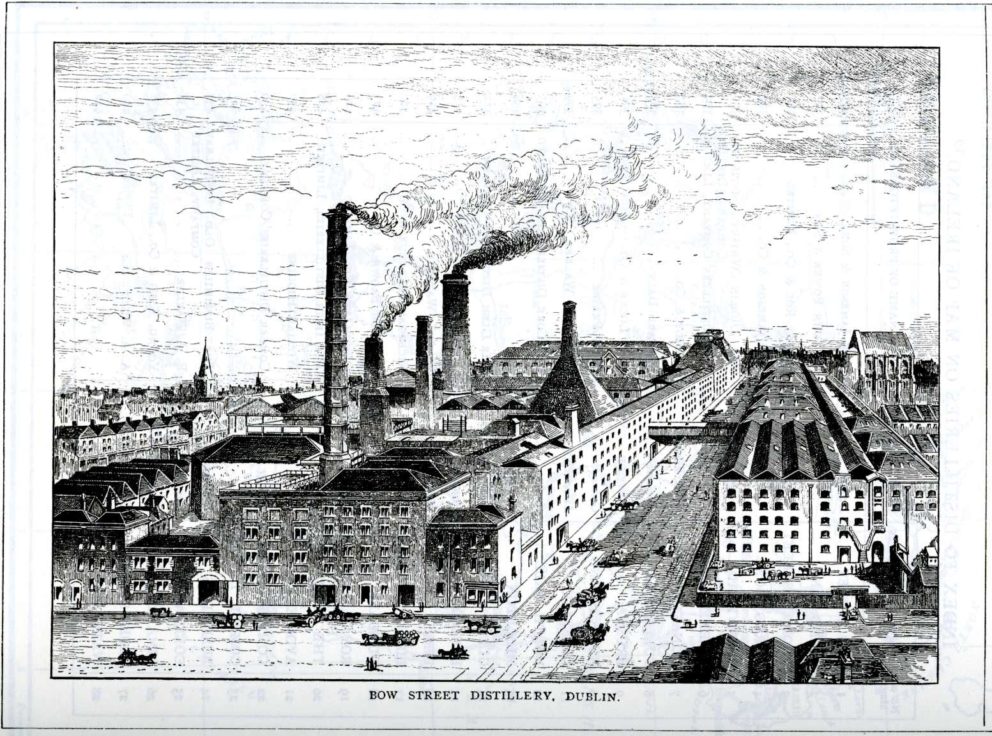
The ground grain and malt were then held in the mash loft before being fed into the mash tuns below by copper sluices. These tuns were extremely large, holding more than 42,000 gallons each, and were fitted with revolving rakes to ensure thorough mixing. Nearby stood four domed copper water heaters, each of 40,000 gallons capacity, fitted with copper attemperating pipes. During production, mashes were made every eight hours, day and night.
After mashing, the wort passed through nine refrigerators, five horizontal and four vertical, before entering the washbacks for fermentation. From there it was sent by copper pipes to the wash charger and then to the wash stills. The spirit was distilled through the feints still and, finally, the spirit still. The vapours then travelled through copper worm condensers stretching for about three quarters of a mile in total, tapering from 18 inches to 4 inches in diameter. The distillery also had three low wine receivers, two feint receivers, and one spirit receiver. A 4-inch copper pipe carried the spirit across New Church Street to the spirit store, which was nearly 150 yards away.
The spirit store contained two 20,000-gallon vats, from which the new spirit was racked into casks using copper measuring vessels called ‘Lord Mayors.’ These wall-mounted vessels allowed spirit to be measured in quantities from one gallon to seventy. The spirit was then moved to bonded warehouses to mature. Jameson used several such warehouses, including sites at Bow Street, Anne Street, and Halpin’s Row, all known for storing and ageing whiskey under suitable conditions. To meet growing demand for J.J. 3 Star Whiskey, a large ferroconcrete store and hydraulic lift had recently been added.
The distillery was powered by three large Lancashire boilers, with gas engines driving the corn lofts and fitting shop, and electricity supplied by the Dublin Corporation generating station for various motors. The Anne Street premises, formerly the Anne Street Brewery owned by Jameson and Pim, had been taken over by John Jameson and Son and converted for whiskey storage. In total, Bow Street Distillery and its annexes occupied between five and six acres.
John Jameson & Son 12-Year-Old (1940s) Review
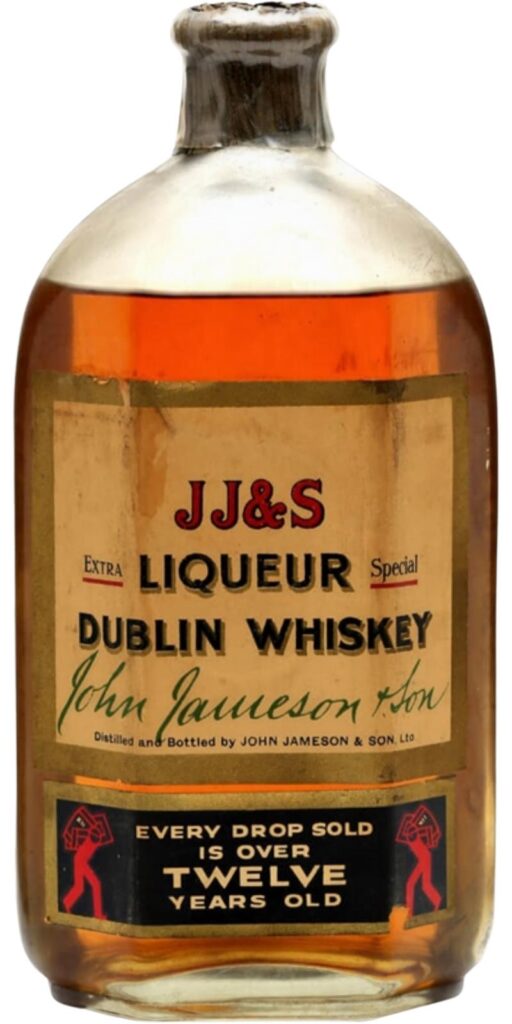
John Jameson & Son 12 Year Old was marketed in this era as an ‘Extra Special Liqueur’ Dublin whiskey, distilled at the original Bow Street distillery in Dublin, decades before its 1975 closure. This late-1930s/early-1940s export bottling was produced with an eye ‘on warehouses full of ageing stock, and another across the Atlantic to a United States’ market re-emerging from Prohibition, positioning the whiskey as a premium, well-aged expression aimed squarely at export demand. Whiskies of this era and naming convention were often sold as ‘Extra Liqueur Special’ and packaged in distinctive hexagonal bottles destined specifically for foreign markets, including Italy. This bottling featured no bottle size nor ABV, but it was probably bottled at 40% ABV. Your only chance to get a bottle will be at auction, but they seem to appear very rarely.
Colour:
Burnished.
Nose:
Neat: Old school, prickly, and dusty pot still character leads, with grassiness – old eucalyptus resin and ointments – and dried apricots intermingling with faint vanilla, engine oil, old paraffin, and candle wax notes – a distinctly industrial, waxy opening typical of genuinely old pot still whiskey. Whispers of pineapple and passion fruit, far less intense as the younger Jameson 12-year-old above. And as time passes with this whiskey in the glass appear some coal smoke and crushed ivy leaves.
Palate:
Neat: The palate is unfortunately a bit weak and fragile, as the ABV dropped to ~32% ABV from what I read on my refractometer, but despite that, it still shows character and intensity. Old orange essential oils, paraffin, with a strong leafy note of ivy, camomile, old tea and basil. Maybe some bay laurel as well. Some bitterness is there as well, with spices (pepper mostly).
Finish:
Medium long and dry, closing on grapefruit bitterness alongside ginger and soft woody notes.
Comments:
On the nose, this venerable Bow Street-era 12-year-old has aged remarkably gracefully in the bottle despite its many decades, retaining genuine complexity rather than succumbing purely to oxidative decline. However, time has not been as gentle on the palate, leaving this old JJ&S leafy, slightly bitter and fragile. But leaving the ‘cold’ tasting notes aside, what a moment it has been. Emotions were high when tasting this piece of time, this time capsule, this testament of old times and bygone distilleries. Putting his emotions aside, this humble reviewer would rate this whisky probably 6 or 6.5 out of 10. But when the emotions come back in, you cannot put a rating on this.
Congratulations Coldorak. What a stroll in time. Thank you for this deepdive and all your reviews. It’s great that it’s not just numbers that matter to you. Please keep it up, though mostly silent, we do hear you. Cheers, Peat
Thanks a lot for the kind comment, Peat, and for being a reader of this blog!