Today marks the beginning of a short series exploring blended Scotch from an earlier era. By ‘earlier’, I mean bottlings from roughly the 1960s through to the 2000s, although the main focus will be on the 1960s and 1970s.
We begin with three blends: Teacher’s Highland Cream, which has (kind of) appeared on the blog before; VAT 69, the long-established William Sanderson blend first created in 1882; and Cameron’s Black Prince, a name that was entirely new to me. Teacher’s and VAT 69 were major historic brands with distinctive identities, while Black Prince offers a more obscure point of comparison.
The aim of this review, and of however many follow, is not simply to indulge in nostalgia. Instead, it is to look at these older bottlings on their own terms and consider the familiar question: was whisky really better in the past?
Teacher’s Highland Cream (early 1970s) Review
Teacher’s Highland Cream is one of Scotland’s most historically significant blended whiskies, first perfected in 1863 and officially registered as a brand name in 1884 by William Teacher & Sons. The blend is distinguished by an unusually high 45% malt whisky content – notably high for a standard commercial blend – built around peated malt from Ardmore distillery, which the company constructed in 1897 specifically to secure a steady supply of smoky Highland malt for the blend, supplemented from 1960 onward by sherried malt from the newly acquired Glendronach distillery, with more than 30 malts in total contributing to the final recipe. This particular bottling dates to the early-to-mid 1970s, a period of particular significance for collectors as the final era of production under independent family ownership, before Allied Breweries acquired the company in 1976.
Bottled at 43% ABV (86 proof) – a strength commonly used for export and 1-litre formats of the era, generally preferred by collectors over the 40% domestic-market equivalent for better preserving aromatic complexity over decades of ageing – chill-filtered, with added colouring. Obviously, you’ll have to rely on auction to get a bottle.
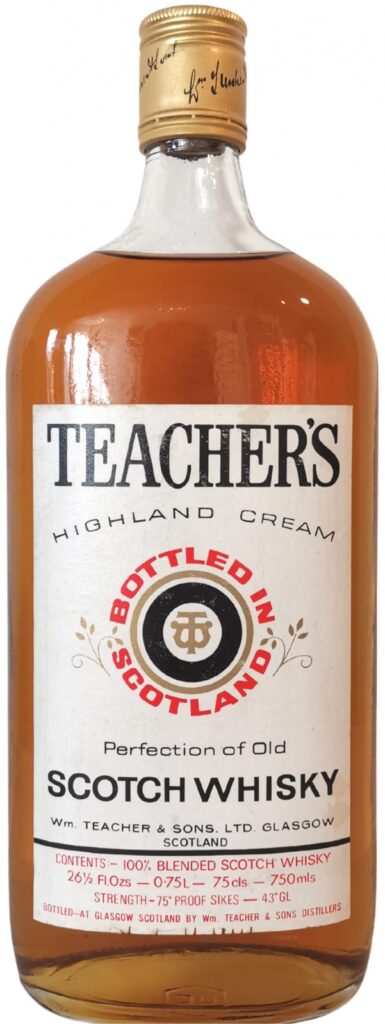
Colour:
Chestnut.
Nose:
Neat: A pleasingly complex opening builds on sooty, slightly earthy smoke, grapefruit, and pear and peach rind, joined by leather, honey, and a touch of icing sugar, with a light sherry influence running throughout, alongside a grainy undertone. After aeration, something reminiscent of rotten fruit peels appears.
Palate:
Neat: Quite dry but well balanced, showing sherry, raisins, toffee, smoke, and leather, alongside caramel and a touch of graininess. A pinch of salt, and a faint medicinal (betadine-like) note, with the sherry slowly softening into a rum and raisin ice cream, rum baba cake sweetness given time. The palate is medium-bodied and slightly prickly.
Finish:
Fruity and smoky with good old bottle effect character, quite sweet, showing white and red grapes, raisins, vanilla, a little coconut, and continued smoke, with leather, icing sugar, and fresh mineral notes appearing late, plus a hint of menthol.
Comments:
This old Teacher’s bottled in the early 1970s (someone glued a handwritten label written 6-4-72 at the back of my bottle) is quite nice, not overly grainy and showing a nice fruitiness and a nice complexity. A shame, the mini I tried to review two years ago was most probably faulty, as it could have been interesting to compare these two bottlings from – probably – the same decade, but with slightly different ABVs.
Rating: 6/10
VAT69 Finest Scotch Whisky (1970s) Review
Vat 69 is one of the most historically storied blended Scotch whiskies, created in 1882 by William Sanderson of Leith, who reputedly laid out around 100 experimental blends in numbered vats and had a panel of tasters select their favourite blind – vat number 69 won unanimously, giving the brand its name. Sanderson secured malt supplies by acquiring Glen Garioch distillery in 1884 and cofounded North British Distillery for grain whisky, ensuring Vat 69 wasn’t dependent on rival blenders for its components. The blend gained further fame for accompanying Sir Ernest Shackleton’s Antarctic expedition in 1914 and later became a fixture in Bollywood films. By the 1970s, the brand was under the ownership of the Distillers Company Limited (DCL), the predecessor to Diageo, having been absorbed in 1937.
This bottling from the 1970s is bottled at 43% ABV in a 760 ml bottle. Vat 69 was bottled at varying strengths across different markets and decades, while some 1970s bottlings (especially in stricter-regulation markets like Australia) were as low as 37.1%, and modern bottlings typically sit at 40%, but it’s a 43% variant I’m tasting, which was bottled for S.I.L.V.E.R. from Firenze, Italy. The blend historically drew on malt whisky from distilleries, including Royal Lochnagar, Teaninich, and Glen Esk, alongside grain whisky, with a malt content estimated around 35% in comparable 1970s–1980s bottlings.
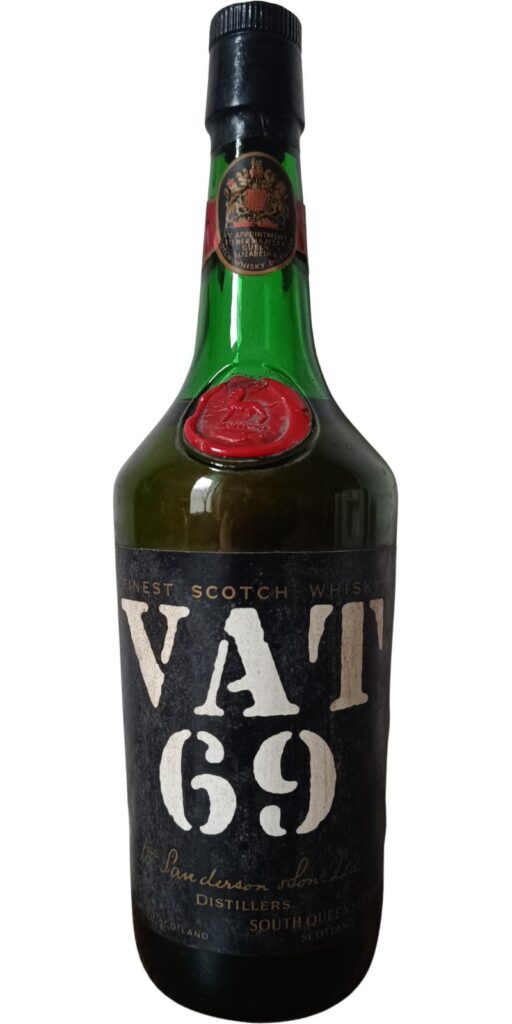
Colour:
Burnished.
Nose:
Neat: Very exciting and unusually complex for a simple blend, showing a nice mix of fruit, ‘dirty’ aromas, and earthy, dusty tones, with an acidity reminiscent of champagne. Some varnish, pear drops, acetone, and a huge amount of polished wood, with a mineral note and a light peat smoke.
Palate:
Neat: Considerably more intense and powerful than the nose suggests, showing fruity barley-sugar sweetness alternating with lighter grain notes, workshop-like and old-denim aromas, and grassy notes over a well-distilled, surprisingly full-bodied spirit. There are flavours of wood and cardboard initially, with faint sherry developing over time alongside butter toffee, wisps of smoke, and a drop of menthol.
Finish:
Genuinely good for such a simple blend, with a long, drying finish with honeycomb and smoke. Peat lingers as if soaking into the tongue, with sherry and caramel sweetness also present.
Comments:
This bottling suggests that at least some blenders in the 1970s knew exactly how to build a convincing blend. The nose is pleasant, but the palate is the real strength: unexpectedly powerful, full-bodied and far more substantial than one might expect. I suspect a direct comparison with a current VAT 69 bottling would not favour the modern release. It is another reminder not to dismiss blends out of hand, particularly older bottlings from the 1970s and earlier.
Rating: 6.5/10
Cameron’s Black Prince (1970s) Review
Cameron’s Black Prince is a blended Scotch whisky produced by D. Cameron & Co. Ltd., a smaller Scottish blending house based in Inverness. This bottling dates to the early 1970s. Beyond the bottler’s name and location, detailed public information about the brand’s history, malt composition, or founding story is limited – D. Cameron & Co. appears to have operated as one of many smaller regional blending houses of the era, producing whiskies primarily for local and export markets rather than achieving major international brand recognition.
Bottled at 43% ABV, 75 cl, marketed under the ‘Specially Blended Old Whisky’ designation, this bottle was imported to Italy by Con. Al Torino. It seems it was bottled by Strathleven Bonded Warehouses, in the Dumbarton factory (though I don’t know if there’s a link with Dumbarton distillery).
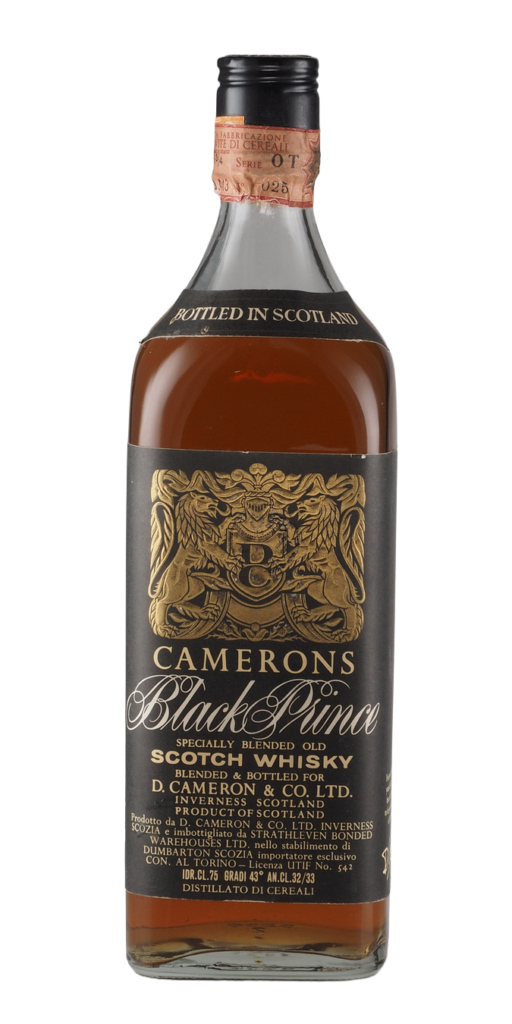
Colour:
Burnished.
Nose:
Neat: Nice complexity again for an old blend, and nice intensity. The nose shows warm wood drying under the sun, lemon peel, figs, massage cream with some camphor, a very light and distant smoke, and some varnish.
Palate:
Neat: The palate shows some intensity, but feels way grainier than the previous Teacher’s and Vat69. Varnish, glue, acetone, and pinewood planks, with some oaky bitterness. There’s a touch of fruit behind all that, with oranges and lemon, and some grassy and leafy notes. The mouthfeel is medium-bodied, but on the lower side of medium.
Finish:
The finish is medium in length, with some leafy and woody flavours lingering, a pinch of pepper, some fermented ginger slices, and some old cardboard.
Comments:
Well, the Black Prince must have been disowned by his royal family, and ended up as a vagrant going from old shacks to shacks, as there is nothing ‘princy’ about this blend. The malt percentage of this blend must be quite low, as this is quite grainy and plankish, unfortunately.