Three permitted adjustments, a few persistent misconceptions, and a rather uncomfortable question about transparency.
Cognac is made from grapes, distilled twice in copper pot stills and matured in oak. Simple enough. But what happens between the cask and the bottle isn’t always quite as straightforward as the romantic descriptions of centuries-old traditions might suggest.
Unlike what some enthusiasts assume, Cognac regulations allow certain adjustments involving sugar, caramel colouring and oak infusions, commonly associated with boisé. None of these automatically makes a Cognac inferior. But they can influence its appearance, texture and, potentially, its flavour. And you won’t necessarily find them mentioned on the label.
So what exactly are producers allowed to add? How do these adjustments work? Can we detect them by tasting? And should we care?
Let’s look at what’s actually permitted, what it can do to the liquid, and why the distinction between traditional craftsmanship and unnecessary manipulation isn’t always as obvious as we’d like.
First, what do the regulations actually allow?
Cognac is a protected geographical indication and a French appellation d’origine contrôlée. Its production is governed by European spirits legislation and the Cognac cahier des charges, which specifies how the spirit must be produced.
These rules are detailed. They cover the geographical area, grape varieties, winemaking, distillation, maturation and other aspects of production. But they don’t require every bottle to contain nothing beyond grape-derived eau-de-vie and water.
The Cognac specification permits three particular traditional adjustment methods:
- Colour adjustment using E150a plain caramel.
- Sweetening with authorised sweetening products to round off the final taste.
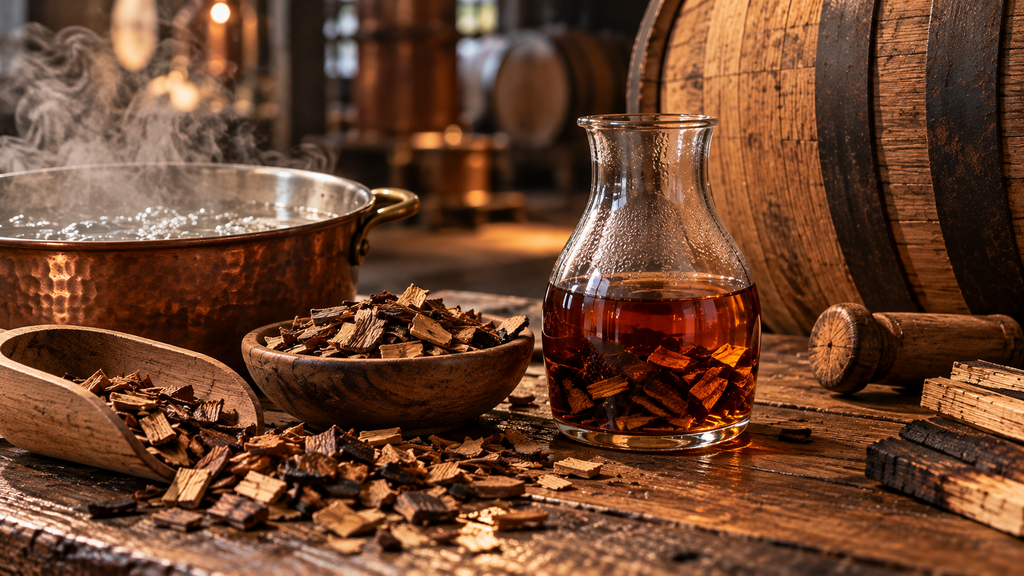
- The addition of an infusion of oak chips in warm water, often discussed under the traditional term boisé.
These are not three unrestricted permissions to flavour Cognac however a producer wishes. They are specifically defined practices, subject to the applicable requirements.
Nor does their inclusion in the regulations mean that every Cognac producer uses them. Some may use one, several or none, depending on the product and the intended style.
An important distinction: permitted does not mean compulsory, and traditional does not mean invisible to the palate.
The legal framework also establishes limits. EU Regulation 2019/787 permits wine spirits to be sweetened to round off their final taste, with a maximum of 20 grams of sweetening products per litre, expressed as invert sugar. The Cognac specification additionally imposes a maximum obscuration of 4% ABV attributable to the permitted adjustment methods.
Those are two different constraints, and they are frequently confused.
We’ll return to obscuration shortly, because it’s probably the most misunderstood number in discussions about Cognac additives.
Caramel: making Cognac look older?
Let’s start with the most familiar adjustment, especially for whisky drinkers.
Caramel colouring is used in many spirits to modify or standardise their appearance. In Cognac, the permitted colouring is E150a, also known as plain caramel.
This is not simply the caramel sauce you might pour over a dessert. E150a is a defined food colouring produced through controlled heat treatment of carbohydrates.
Its primary purpose in Cognac is colour adjustment.
Oak maturation naturally changes the colour of an eau-de-vie. A young spirit begins essentially colourless, then extracts wood-derived compounds that can give it shades ranging from pale gold to deep amber and mahogany.
But colour development depends on numerous factors: the type of oak, cask age, previous use, maturation conditions and time spent in wood.
Two eaux-de-vie of similar ages may look very different.
For a large producer seeking a consistent appearance across successive batches, this presents a practical problem. Consumers expect a familiar bottle to look familiar, and colour is part of that expectation.
A little caramel colouring can help maintain that consistency.
But it also means that the colour of a Cognac is not a reliable indicator of its age.
A darker Cognac is not necessarily older, more concentrated or more heavily matured. And a pale Cognac is not necessarily young.
Of course, caramel colouring isn’t the only reason for those differences. Natural maturation alone can produce a wide range of colours.
The problem is that, without additional information, we generally cannot separate the contribution of oak from that of added colouring simply by looking at the glass.
Does caramel colouring affect flavour?
This is where the discussion becomes more complicated.
E150a is authorised for colour adjustment, not as an unrestricted flavouring ingredient. Its intended function is visual.
But saying that its purpose is colouring is not quite the same as proving that any possible quantity has absolutely no sensory impact.
The composition of caramel colouring depends on how it is manufactured, and its contribution to a finished drink depends on the particular product and concentration used.
At the small concentrations typically associated with colour correction, any sensory effect may be negligible compared with the Cognac’s existing aroma and flavour.
However, without knowing the actual dosage, I wouldn’t claim that caramel colouring can never influence perception.
Nor would I claim that every Cognac displaying burnt sugar, caramel or toffee aromas must contain E150a.
Those characteristics can arise naturally during maturation through reactions involving wood-derived compounds and the complex evolution of the eau-de-vie.
A tasting note mentioning caramel is not a laboratory analysis.
And a dark colour is not proof of added caramel.
Sugar: rounding off the rough edges
Sweetening is probably the adjustment most likely to provoke strong opinions.
Some enthusiasts consider any added sugar unacceptable in a premium spirit. Others see it as a legitimate way of balancing a blend, particularly in a category with centuries of blending traditions. I tend to lean towards the first group, but I can understand the view of the second group.
The regulations allow authorised sweetening products to be used to round off the final taste of Cognac.
That wording matters. Sweetening is permitted for a defined purpose, not as an unrestricted licence to turn Cognac into a liqueur.
The applicable European wine-spirit category sets a maximum of 20 g/L of sweetening products, expressed as invert sugar. That is a legal ceiling, not a typical recipe or evidence that Cognac producers routinely use anything close to that amount.
The actual quantity in an individual Cognac may be zero, very small or more noticeable. Without disclosure or appropriate analysis, we shouldn’t pretend to know.
And there is another important distinction: the presence of sugars or sugar-related compounds in a spirit doesn’t necessarily mean that sugar was added during blending.
Wood can contribute soluble carbohydrates and their derivatives. Maturation and permitted production practices can also influence the composition of the finished spirit.
A measured sugar concentration, by itself, does not always tell us how that sugar arrived there.
What does sugar actually do?
The most obvious effect is sweetness. But the sensory impact of sugar is more interesting than simply making something taste sweeter.
Sweetness can alter the perceived balance of other tastes. It may soften the impression of bitterness, acidity or astringency, depending on the composition of the spirit and the amount added.
It can also influence the overall perception of roundness and texture, although the relationship between sugar concentration and mouthfeel is not as straightforward as some marketing descriptions suggest.
This is particularly relevant in Cognac, where tannins, acidity, alcoholic strength and aromatic intensity interact.
Imagine a blend with attractive fruit and spice but a slightly drying finish. A small adjustment may make the overall impression more harmonious.
But there is a difference between improving balance and masking an underlying problem.
A heavily sweetened spirit may feel smoother initially while becoming cloying, less precise or less expressive. On the other hand, a modest adjustment may be difficult to identify sensorially and may genuinely improve the finished blend.
The question isn’t simply whether sugar is present.
It’s how much, why it was used, and what effect it has on the final Cognac.
Can you taste added sugar?
Sometimes you may suspect it. But suspicion isn’t proof.
A Cognac can taste sweet without containing added sugar. Fruity aromas, vanilla, caramel-like notes and the interaction between alcohol and other compounds can all contribute to perceived sweetness.
Conversely, a Cognac containing a modest quantity of added sugar may not taste obviously sweet, particularly if it also has pronounced tannins, acidity or other balancing characteristics.
This is one of the reasons I dislike seeing precise sugar-addition claims based entirely on tasting notes.
This Cognac tastes sweet; therefore, it contains 12 grams of added sugar per litre.
That’s not how analytical chemistry works.
A laboratory can measure relevant compounds, although distinguishing their origin may require more than a basic sugar test. But our palates cannot reliably identify the quantity of added sugar, let alone establish whether it was introduced deliberately.
We can describe what we perceive. We should be considerably more cautious about explaining its cause.
Boisé : the most misunderstood adjustment?
Now for the most interesting of the three.
The word boisé literally refers to something woody. In Cognac production, it is commonly used for preparations intended to contribute oak-derived character to an eau-de-vie or blend.
The popular description is rather dramatic: oak chips are boiled in water until they produce a dark, concentrated liquid, which is then added to Cognac.
There is some truth behind that image, but we need to distinguish commercial or historical descriptions from the exact method authorised by the specification.
The published Cognac specification describes the addition of an infusion of oak chips in warm water as a permitted traditional method. The wood must be of a type consistent with the oak used for Cognac maturation, and the infusion may be stabilised with a corresponding wine spirit.
This is more precise than saying producers can add any concentrated wood extract they like.
The distinction matters because boisé is often discussed as though it were an entirely unregulated flavour concentrate. It isn’t.
And the fact that a method is traditional doesn’t mean we should ignore what it can contribute to the finished spirit.
What does boisé actually contribute?
Oak contains numerous substances that can be extracted into a liquid. Their composition and extraction depend on the wood species, its preparation, temperature, contact time and other conditions.
An oak infusion may contain compounds contributing woody, tannic, bitter, astringent or other sensory characteristics.
Depending on its composition, it can influence colour, taste and mouthfeel. Its contribution won’t necessarily resemble the complete aromatic profile developed through prolonged maturation.
And that’s a crucial distinction.
During maturation, the eau-de-vie doesn’t merely extract compounds from oak. It undergoes chemical transformations, exchanges with its environment and loses volatile substances through evaporation.
Adding an oak infusion cannot reproduce all those processes.
It may contribute certain wood-derived characteristics associated with maturation, but it doesn’t turn a young Cognac into a genuinely old one.
You can add oak character.
You cannot add twenty years.
Is boisé a shortcut to maturity?
It can be tempting to describe it that way.
An oak infusion might help adjust the woody or tannic profile of a blend. Depending on how it is prepared and used, it could contribute characteristics that consumers associate with longer maturation.
But treating boisé simply as a fraudulent substitute for ageing would be misleading.
The Cognac still has to meet the appellation’s actual ageing requirements. A two-year-old eau-de-vie doesn’t become an XO because somebody adds an oak infusion.
And blending is itself an established part of Cognac production. Producers combine eaux-de-vie with different aromatic profiles, ages and maturation histories to achieve a desired result.
An adjustment may be used to refine that result, rather than to disguise an obviously immature spirit.
Whether we consider that desirable is a separate question.
Personally, I tend to favour spirits where the character comes primarily from the distillate and its maturation. But that preference doesn’t make every permitted adjustment illegitimate, nor does it establish that every Cognac made without boisé will taste better.
The glass still matters.
Boisé is not the same as ageing with oak chips.
There’s another distinction worth making.
Adding an authorised oak infusion to Cognac isn’t the same process as ageing the eau-de-vie in a cask. Nor should it be confused with putting oak chips directly into a container and counting that as traditional Cognac maturation.
The specification requires Cognac maturation to take place in oak containers under prescribed conditions.
The permitted infusion is an adjustment method, not an alternative ageing vessel.
This distinction is important because wood extraction and maturation are sometimes treated as interchangeable in discussions about spirits.
They aren’t.
Oak compounds are part of maturation, but maturation involves much more than their extraction.
If all we needed to produce mature Cognac were wood-derived substances, producers could simply prepare an infusion, mix it with new eau-de-vie and forget about decades in cellars.
Fortunately, the chemistry is considerably more interesting than that.
The famous 4% obscuration rule.
Now we reach one of the most frequently misunderstood aspects of Cognac production.
You’ll sometimes read that Cognac can contain up to 4% additives. Others interpret the figure as permission to add 4% sugar, or claim that it corresponds to a specific number of grams per litre.
Neither interpretation is correct.
The relevant limit concerns obscuration, expressed as a difference in alcoholic strength by volume.
When measuring the alcoholic strength of a spirit using density, dissolved substances other than ethanol and water can interfere with the result.
A conventional alcoholmeter relies on the relationship between density, temperature and the composition of an ethanol-water mixture. But a real spirit may contain other substances, including sugars and wood-derived compounds.
Those substances can alter the liquid’s density, making the apparent alcoholic strength differ from the true alcoholic strength.
The Cognac specification defines obscuration as the difference between the actual alcoholic strength and the gross or apparent alcoholic strength.
For example, imagine a Cognac whose true alcoholic strength is 40.0% ABV, while its apparent strength, measured without correcting for the dissolved substances, is 38.5%.
The obscuration is:
40.0 − 38.5 = 1.5 percentage points of alcohol by volume.
That doesn’t mean the Cognac contains 1.5% sugar. Nor does it mean that 1.5% of the bottle consists of added ingredients.
It means that dissolved substances have affected the density-based measurement sufficiently to create that difference.
The Cognac specification limits the obscuration attributable to the permitted adjustment methods to 4% ABV.
And here’s the crucial point: 4% obscuration is not a recipe, a sugar concentration or permission to add 4% of anything by volume.

Why obscuration doesn’t tell us everything.
The obscuration limit is an important regulatory control, but it doesn’t tell us precisely which substances are present.
Different compounds affect density differently. Their concentrations and interactions matter, and the relationship between a measured obscuration and the amount of any particular ingredient isn’t necessarily straightforward.
So we cannot look at a Cognac with a certain obscuration and calculate its exact sugar, caramel and boisé additions from that number alone.
Nor can we assume that every dissolved substance contributing to density originates from a deliberate adjustment.
Maturation itself introduces non-volatile compounds from wood.
That is why the regulatory wording about the effect of permitted adjustment methods matters.
Obscuration is useful, but it isn’t a complete ingredient analysis.
And it certainly isn’t a magic number that tells us how natural or manipulated a Cognac is.
Wait, isn’t there also a 20 g/L sugar limit?
Yes. And it is a separate requirement.
The EU wine-spirit category permits sweetening to round off the final taste, subject to a maximum of 20 g/L of sweetening products expressed as inverted sugar.
The Cognac specification also imposes its obscuration limit.
These constraints are not interchangeable. A producer must comply with the applicable requirements, rather than choosing whichever limit seems more generous.
This is where some explanations of Cognac additives become particularly misleading.
A 4% obscuration allowance cannot simply be converted into 40 g/L of sugar, or any other convenient number, without specifying the substances involved and the relevant analytical relationships.
And a legal ceiling should never be presented as the amount normally added.
A maximum is a maximum.
Not a typical dosage.
Are these adjustments always declared on the label?
This is where I think the discussion becomes genuinely uncomfortable.
When I buy a bottle of Cognac, I can usually find its alcoholic strength, volume, producer or bottler, and sometimes its cru, age category or vintage.
What I generally cannot determine from the ordinary front label is whether the producer used caramel colouring, sweetening or an oak infusion.
The fact that a Cognac doesn’t advertise those adjustments doesn’t establish that none were used.
But the reverse is equally important: the absence of a declaration is not evidence that they were used.
For alcoholic beverages above 1.2% ABV, the general EU framework has historically provided exemptions from mandatory ingredient lists and nutrition declarations, subject to specific requirements and developments in the law.
So the information available to consumers is often much less detailed than it would be for many ordinary food products.
Some producers voluntarily explain their methods. Others make statements such as no added sugar, no caramel or no boisé.
Those can be useful commitments, particularly when the producer is willing to explain exactly what they mean.
But we shouldn’t assume that silence means anything definite.
What about ‘natural colour’?
For whisky drinkers, this expression is familiar.
In Scotch whisky, natural colour generally indicates that the producer hasn’t added caramel colouring. It’s a useful disclosure, even if it doesn’t tell us everything about the whisky’s production.
In Cognac, similar statements may be used voluntarily, but we should read them carefully.
A Cognac described as having a natural colour may be indicating that no colouring was added. That doesn’t automatically tell us whether sweetening or an oak infusion was used.
Likewise, a statement about the absence of added sugar doesn’t necessarily address caramel colouring or boisé.
And natural is an especially slippery word in spirits marketing.
A Cognac can be naturally coloured by oak yet undergo a reduction with water. It can be bottled at natural cask strength yet have a particular maturation history. And it can be free from added caramel without being free from every other permitted adjustment.
If we want transparency, specific statements are much more useful than broad claims of naturalness.
No added sugar. No E150a. No oak infusion.
Those tell us considerably more than 100% authentic Cognac, which sounds reassuring but says very little about the actual production methods.
Is Cognac less transparent than whisky?
In some respects, the comparison is interesting.
Scotch whisky regulations permit caramel colouring, while other practices are restricted by the Scotch Whisky production framework. Cognac has its own historical methods and regulatory allowances, including sweetening and oak infusions.
Neither category can be reduced to a simple distinction between natural and artificial.
And neither is universally transparent.
A whisky bottle may tell us that it is non-chill filtered and naturally coloured, but may reveal very little about the casks used in its composition. A Cognac bottle may identify an exceptional vintage and cru while saying nothing about permitted adjustments.
The information available depends heavily on the producer and bottler.
For enthusiasts who care about production details, voluntary disclosure can make a substantial difference.
I don’t necessarily need every Cognac to follow the same philosophy. But I appreciate knowing which philosophy the producer has chosen.
Can we identify additives by tasting?
Not reliably enough to make definitive claims.
A dark Cognac isn’t proof of E150a. A sweet Cognac isn’t proof of added sugar. And pronounced woody characteristics aren’t proof of boisé.
All three can have other explanations.
Oak maturation can produce colour, sweetness-associated aromas and substantial woody or tannic character. Blending can also change the overall sensory balance.
That doesn’t mean tasting is useless. Quite the opposite.
We can describe a Cognac as sweet, syrupy, heavily woody, tannic, thin, balanced or remarkably natural in character. Those observations are valuable.
But they should remain observations.
If I taste a Cognac that feels excessively sweet and woody, I can criticise that profile. I don’t need to claim that the producer must have added sugar and boisé unless I have evidence.
Likewise, if a Cognac is beautifully balanced, I cannot conclude that it contains no adjustments simply because I can’t detect them.
Tasting can tell us what we experience.
It cannot reliably reconstruct every production decision.
What about laboratory analysis?
Laboratory analysis can provide considerably more information than tasting alone, but it isn’t always as simple as measuring one compound and identifying its origin.
Sugars can be measured. Colour and absorbance can be measured. Alcoholic strength and obscuration can be determined using appropriate methods.
However, the interpretation of those measurements requires care.
A measured concentration of sugar doesn’t automatically prove deliberate sweetening. A particular colour doesn’t identify how much caramel was added. And detecting oak-derived compounds doesn’t establish whether they came from maturation in a cask or an authorised infusion.
To distinguish sources, researchers may need more sophisticated analytical methods, reference samples and knowledge of the production history.
Even then, some questions may remain difficult to answer conclusively.
So while analysis can test specific claims, it shouldn’t be treated as a universal detector of every adjustment ever made to a Cognac.
The most useful information often comes from combining analytical evidence with reliable producer documentation.
Does using additives mean the Cognac is inferior?
No. But that doesn’t mean the question is irrelevant.
A permitted adjustment may improve the balance or consistency of a blend. It may also produce a profile that some enthusiasts find less appealing.
The effect depends on what is used, how much is used and the character of the original eaux-de-vie.
For me, the distinction is between what is legally permitted, what is sensorially successful and what I personally prefer.
Those are three different questions.
A Cognac can comply perfectly with the regulations and still disappoint me. Another can use a permitted adjustment and remain genuinely enjoyable.
And a Cognac made without any of these additions can still be unbalanced, over-oaked or simply boring.
Production purity is not a substitute for quality.
But quality isn’t a reason to dismiss transparency either.
If two producers achieve similarly excellent results, and one is willing to explain precisely how the Cognac was made, I find that information valuable.
It allows me to understand what I’m drinking rather than relying entirely on marketing language.
My preference: let the eau-de-vie speak.
Readers of More Drams Less Drama probably won’t be surprised by my preference.
In whisky, I tend to favour bottlings where the distillate remains expressive, the oak is well integrated and the producer doesn’t seem determined to make every release look and taste identical.
The same applies to Cognac.
I appreciate fruit, freshness, complexity and texture. I enjoy the mature walnut, mushroom, leather and oxidative characteristics associated with rancio, but I don’t want every old Cognac to taste like a concentrated oak extract. And I prefer tropical fruits anyway.
And I don’t automatically consider sweetness a virtue.
Some of the most compelling Cognacs I’ve tasted have impressed me precisely because they combine extraordinary maturity with freshness and balance.
But I wouldn’t use that preference to argue that every adjustment is necessarily harmful.
If a producer chooses not to use sugar, caramel or boisé, that’s interesting. If another producer uses a modest adjustment to achieve a particular style, I want to understand that decision too.
The problem isn’t necessarily the adjustment itself.
It’s the difficulty of knowing what has been done.
The problem with romantic production stories.
Cognac has a wonderful history, and producers understandably like to talk about it.
Centuries of tradition. Family cellars. Copper stills. Limousin oak. Generations of cellar masters preserving precious eaux-de-vie.
Much of that history is real, and it deserves to be celebrated.
But tradition is not the same as an absence of intervention.
Blending, reduction, cask management and permitted adjustments are also part of Cognac’s production history.
There’s nothing inherently contradictory about a traditional spirit involving deliberate technical decisions.
The contradiction appears when marketing encourages consumers to imagine that nothing happens between the cask and the bottle, while providing little information about the choices actually made.
I would rather have a producer explain that a Cognac was carefully blended and adjusted to achieve a consistent house style than imply that its character emerged entirely by accident.
Craftsmanship involves decisions.
And explaining those decisions doesn’t make the product less authentic.
Should producers disclose everything?
That’s a more complicated question than it might initially appear.
Some producers may regard blending methods and adjustment quantities as commercially sensitive information. Others may consider detailed technical disclosures unnecessary for their customers.
And not every consumer wants to read a laboratory report before enjoying a glass of Cognac.
Fair enough.
But there’s a substantial difference between revealing a proprietary recipe and providing basic information about the use of permitted adjustments.
A producer could disclose whether sugar, caramel colouring or an oak infusion was used without necessarily revealing the exact proportions or every blending decision.
That would already represent a meaningful improvement in transparency.
It would also allow consumers to make informed choices without treating every undisclosed detail as suspicious.
Because the alternative is rather unsatisfactory, enthusiasts are speculating about additions based on colour and sweetness, while producers who use none may receive no credit for their approach.
Better information would benefit both.
Too long, didn’t read
(Apparently, even the additives get a TL;DR.)
Cognac regulations permit three traditional adjustment methods: E150a caramel colouring, authorised sweetening products and an infusion of oak chips in warm water.
Caramel is used to adjust colour. Sweetening can round off the final taste. Oak infusions can contribute wood-derived characteristics. None of these methods replaces the mandatory maturation of Cognac in oak.
The EU wine-spirit category establishes a maximum of 20 g/L of sweetening products, expressed as invert sugar. The Cognac specification also limits the obscuration attributable to permitted adjustments to 4% ABV.
That 4% figure is not the percentage of additives in the bottle, nor is it a direct measurement of sugar concentration.
These adjustments are permitted, but not compulsory. Their presence or absence generally cannot be established reliably from colour, sweetness or tasting notes alone.
And a Cognac made without them isn’t automatically better than one containing a modest permitted adjustment.
The important questions are what was used, why it was used, what effect it had and whether the producer is willing to explain it.
Conclusion: what’s really in your Cognac?
The short answer is that we often don’t know everything.
We know Cognac must comply with detailed rules governing its origin, production and maturation. We know certain traditional adjustments are permitted, and we know that those adjustments can influence the finished spirit.
What we don’t necessarily know is whether they were used in the particular bottle sitting in front of us.
And that’s where I think the discussion should focus.
Not on declaring every Cognac containing sugar or boisé inferior. Not on assuming that every large producer manipulates its products. And certainly not on pretending we can identify exact additions simply by looking at the colour or tasting a little sweetness.
I’d rather see producers being more open about their methods, and enthusiasts being more precise about what they can actually establish.
Because ultimately, the most important question isn’t whether a Cognac conforms to somebody’s idealised image of traditional production.
It’s whether the liquid is good, whether its character reflects the choices made during production, and whether we have enough information to understand those choices.
I don’t expect every Cognac to be made the same way.
But I’d certainly appreciate knowing a little more about what’s in my glass.
References and further reading
- French Ministry of Agriculture (2026). Arrêté du 10 juin 2026 homologuant le cahier des charges de l’appellation d’origine contrôlée « Cognac » ou « Eau-de-vie de Cognac » ou « Eau-de-vie des Charentes ». Légifrance — 10 June 2026 decree.
- European Commission (2023). Publication of an approved standard amendment to the Cognac geographical indication specification, Official Journal of the European Union, 2023/C 123/14. EUR-Lex – Cognac specification.
- BNIC. Cognac, une appellation d’origine contrôlée. Cognac.fr — Une origine contrôlée.
- BNIC, Station Viticole. Fiche technique d’alcoométrie. BNIC technical document, archived on Yumpu.
- Difford’s Guide. Cognac Production: Grapes, Distillation, Maturation. Difford’s Guide – Cognac production.
- Cognac-Expert Blog. Obscuration: the 3 permitted Additives. Cognac-Expert Blog.