
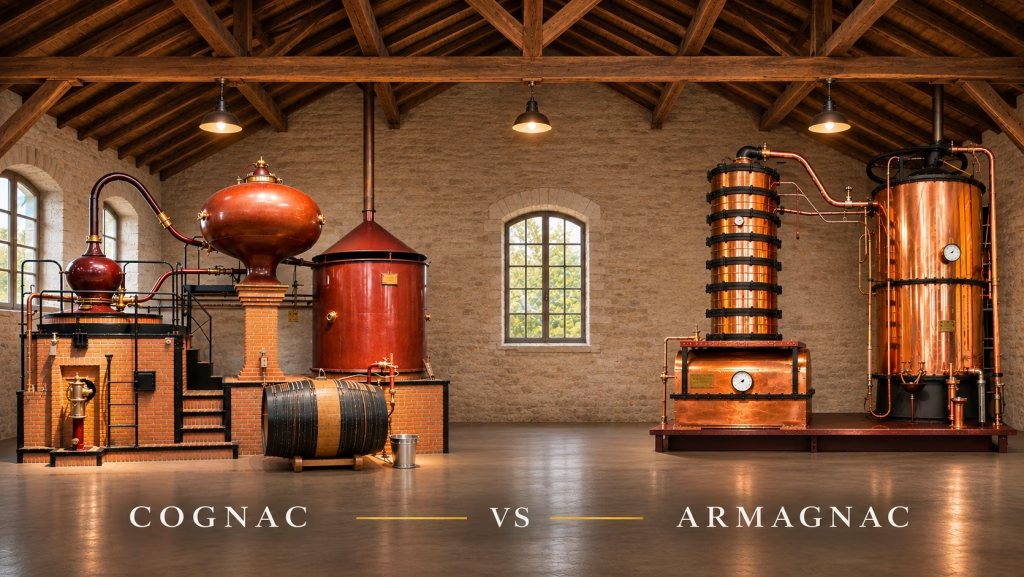
Grapes, terroir, copper stills, oak and ageing: what really separates France’s two most famous wine spirits, and why the differences aren’t always what you think.
If you ask someone to explain the difference between Cognac and Armagnac, there’s a good chance you’ll get something along these lines: Cognac is double-distilled, elegant and refined, while Armagnac is single-distilled, rustic and full of character.
It’s a convenient explanation. It also manages to oversimplify several centuries of history, two sets of production regulations and a rather substantial amount of chemistry in a single sentence. Impressive, really.
Both spirits are French grape brandies. Both originate from specific geographical areas, both are protected by appellations, and both are produced by distilling wine before, in most cases, ageing the resulting spirit in oak. They share grape varieties, certain production techniques and many of the chemical processes responsible for their aromas.
Yet they can taste remarkably different.
The usual explanation focuses almost entirely on distillation, and there is certainly a good reason for that. The traditional Charentais pot still and the continuous Armagnac still operate differently, influencing which compounds are concentrated, retained or removed from the original wine. But distillation is only one part of the story.
The grapes matter. The composition of the wine matters. Copper contact, distillation strength, the selection of fractions, the wood, the warehouse and the decisions made by the cellar master all contribute to the final result.
And just as with whisky, there is an important distinction between understanding why two spirits can taste different and claiming that they must taste different.
So, let’s put the usual clichés aside and look at what actually separates Cognac and Armagnac.
Two regions, two histories
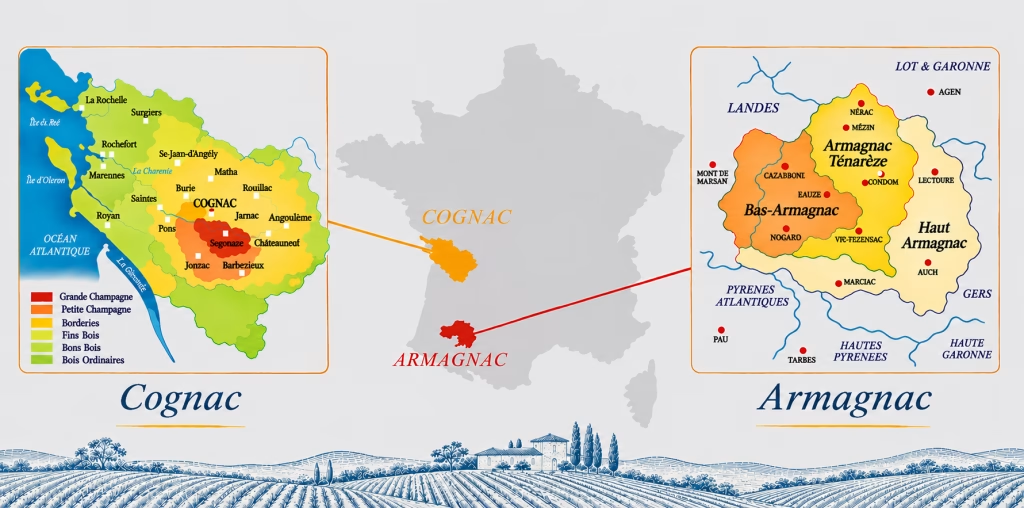
Cognac is produced in western France, primarily across Charente and Charente-Maritime, with the appellation extending into parts of neighbouring departments. Its development was closely connected to Atlantic trade, particularly with northern European merchants.
Wine from the region was already being exported long before Cognac became the spirit we know today. Distillation offered a way to concentrate the wine, making it easier to transport and less vulnerable to deterioration during long journeys. Over time, producers discovered that storage in wooden casks could transform the resulting eau-de-vie into something considerably more interesting.
Armagnac comes from Gascony, further south, principally in Gers, Landes and Lot-et-Garonne. Its commercial development followed different geographical and economic circumstances, with inland trade routes and a strong tradition of production at individual estates.
Armagnac is frequently described as France’s oldest eau-de-vie, with a well-known written reference dating to 1310, attributed to Vital du Four. That makes for a wonderful historical introduction, although it shouldn’t be confused with evidence that modern Armagnac was being produced in precisely the same way seven centuries ago.
Distillation technology, grape varieties, vineyard practices and maturation techniques have changed enormously since then.
The distinction between the two regions is therefore historical as well as geographical. Cognac developed a particularly strong culture of large-scale trading houses and blending, while Armagnac retained a highly visible tradition of estate production, individual vintages and smaller producers.
These are tendencies, not absolute rules. Cognac has independent growers producing distinctive single-estate eaux-de-vie, while Armagnac also has négociants, established houses and sophisticated blending operations.
The idea that Cognac is industrial and Armagnac artisanal is an appealing marketing story. Reality, as usual, is less cooperative.
Geography and terroir: six crus versus three areas
Cognac’s six crus
The Cognac appellation is divided into six recognised growing areas, traditionally called crus:
- Grande Champagne
- Petite Champagne
- Borderies
- Fins Bois
- Bons Bois
- Bois Ordinaires, also referred to as Bois à Terroirs
Grande and Petite Champagne are particularly associated with chalk-rich soils and eaux-de-vie valued for their ageing potential. Borderies has its own reputation for floral and sometimes violet-like characteristics, while the Bois crus encompass a broader variety of soils and growing conditions.
These descriptions are useful as generalisations, but terroir does not function as an automatic flavour dispenser. A Grande Champagne Cognac is not guaranteed to be more elegant than a Fins Bois Cognac; any more than an Islay whisky is guaranteed to be smoky.
Soil affects vine growth, water availability, grape composition and ripening. Those differences can influence the resulting wine and, ultimately, the distillate. However, fermentation, distillation and maturation introduce additional variables that can amplify, transform or obscure the original differences.
One label worth understanding is Fine Champagne. Despite the name, it has nothing to do with sparkling wine. In Cognac, it designates a blend of eaux-de-vie from Grande Champagne and Petite Champagne, with at least 50% coming from Grande Champagne.
Armagnac’s three geographical denominations
Armagnac has three principal geographical denominations:
Bas-Armagnac is particularly associated with sandy and silty soils, including the famous sables fauves. Its eaux-de-vie are often described as fruity, aromatic and capable of developing considerable finesse.
Armagnac-Ténarèze includes a variety of clay-limestone and related soils. Traditional descriptions frequently emphasise structure, power and the potential for extended maturation.
Haut-Armagnac occupies a much larger geographical area but represents a comparatively small part of production. Its landscape and soils differ from those of the other two denominations.
As in Cognac, these descriptions are tendencies rather than guarantees. A particularly delicate Ténarèze or a powerful Bas-Armagnac isn’t violating any law of nature.
The geographical denominations tell us where the grapes come from and which production requirements apply. They don’t provide a complete sensory profile.
The important distinction: terroir influences the raw material, but the character of a finished brandy emerges from the entire production chain.
The grapes: more in common than you might expect.
Both Cognac and Armagnac are produced from wine, and both rely heavily on white grape varieties selected for their suitability for distillation rather than for making particularly enjoyable table wine.
This distinction matters.
A wine intended for distillation doesn’t necessarily benefit from the same characteristics as a wine intended for drinking. Producers generally seek relatively low alcohol, substantial acidity and a suitable balance of aroma precursors.
Ugni Blanc : the common foundation
Ugni Blanc, known in Italy as Trebbiano Toscano, dominates Cognac production and is also widely used in Armagnac.
It offers several advantages: good productivity, high acidity, relatively modest potential alcohol and characteristics that make it suitable for distillation.
High acidity is particularly important because wines intended for distillation may need to remain stable for weeks or months before passing through the still. Both appellations restrict the use of sulphur dioxide, making the condition of the wine and the timing of distillation especially important.
The objective is not necessarily to produce a wine with spectacular aromas. Much of the eventual aromatic complexity of a brandy develops through fermentation, distillation and maturation.
Armagnac’s wider grape identity
Armagnac has a particularly interesting relationship with several other varieties.
Baco Blanc, also called Baco 22A, is an interspecific hybrid developed after the phylloxera crisis. It remains an authorised and important variety in Armagnac, especially in Bas-Armagnac. This is a striking exception in a French appellation landscape where hybrids are often treated with considerable suspicion.
Baco can contribute distinctive fruit character and is frequently valued for its ageing potential, although the final result depends heavily on the producer.
Folle Blanche is another historically important variety. Before phylloxera, it played a much greater role in French brandy production. Today, it remains prized by some producers for its aromatic delicacy, but it is more demanding in the vineyard.
Colombard can contribute aromatic intensity and freshness, while the appellation also permits several less commonly encountered varieties.
Cognac likewise authorises more than Ugni Blanc, including Folle Blanche and Colombard, although Ugni Blanc overwhelmingly dominates contemporary production.
This gives Armagnac producers more opportunities to emphasise varietal identity, particularly through single-variety bottlings. But it would be wrong to conclude that Cognac’s relatively homogeneous vineyard necessarily produces homogeneous spirits.
Different fermentation conditions, distillation decisions and cask histories can create enormous variation even when the grape variety remains unchanged.
The base wine: acidity, fermentation and lees
Before discussing the stills, we need to consider what actually goes into them.
The raw material is not simply alcohol dissolved in water. Wine contains a complicated mixture of organic acids, higher alcohols, esters, aldehydes, fatty acids, nitrogen-containing compounds and numerous other substances.
Some are already aromatic. Others are precursors that can participate in chemical reactions during distillation.
The composition of the wine is influenced by grape variety, ripeness, fermentation temperature, yeast metabolism, nutrient availability and the handling of the wine after fermentation.
This means that two producers using identical stills can obtain noticeably different spirits before the influence of oak is even considered.
Why high acidity matters
The relatively high acidity of distillation wines helps limit microbial deterioration before distillation. This is particularly useful because added sulphites are restricted.
Acidity also influences chemical reactions during heating. For example, acid-catalysed reactions can contribute to the formation or transformation of certain aroma compounds.
However, acidity isn’t automatically beneficial in unlimited quantities. The composition and condition of the wine remain essential, and volatile acidity caused by microbial spoilage is a different matter from the desirable natural acidity of the base wine.
Distilling with or without lees
Lees consist of yeast cells and other particles remaining after fermentation. Their presence can influence the composition of the wine and the spirit obtained from it.
Yeast-derived compounds and fatty acids can contribute to the formation or retention of aroma-active substances, including certain esters. But lees also affect heating behaviour and can introduce undesirable characteristics if poorly managed.
In Cognac, distillation with or without fine lees is an important production choice. Different houses and growers have their own preferences, often connected to the style of eau-de-vie they want to produce and its intended maturation.
This is worth emphasising because discussions of Cognac versus Armagnac sometimes treat the still as though it were the only meaningful variable.
The still can only work with the wine it receives.
And a very sophisticated copper still cannot turn a badly spoiled wine into an exceptional spirit merely through the power of French tradition.
Distillation: the most important technical difference
Here we reach the distinction most commonly used to separate the two spirits.
Cognac is produced using the traditional Charentais double-distillation process. Armagnac is predominantly produced using a continuous still specifically associated with the appellation.
But Armagnac regulations also permit batch distillation in a pot still, so the familiar statement that Armagnac is always single-distilled is incorrect.
More importantly, single versus double distillation does not, by itself, tell us how many flavour compounds remain in the final spirit.
To understand why, we need to look at how the two systems operate.
Cognac’s traditional double-distillation apparatus and Armagnac’s continuous still share copper and wine, but operate differently.
Cognac
Alambic charentais · Double batch distillation
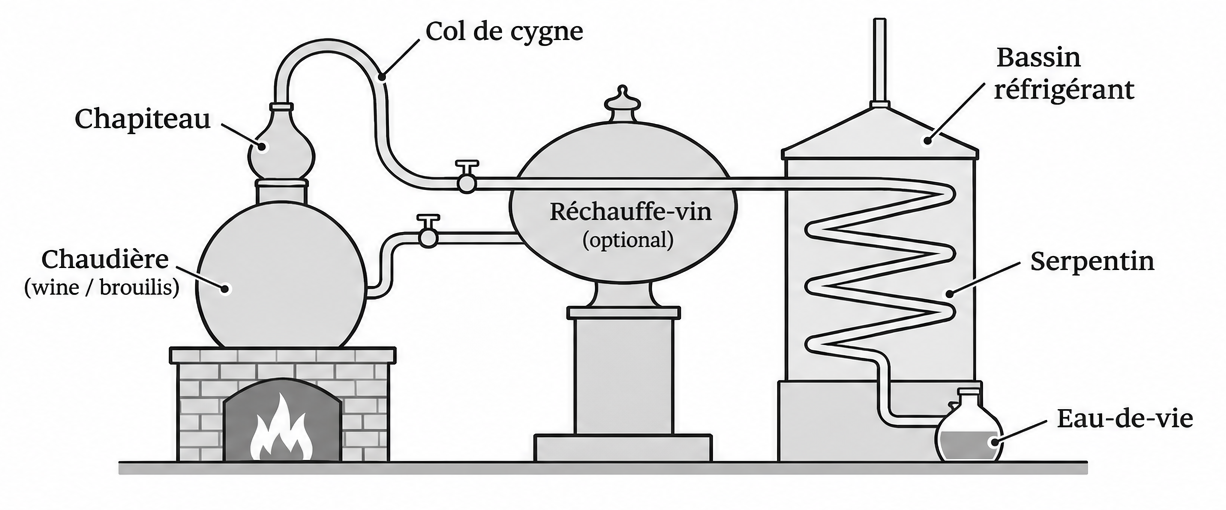
Traditional Charentais pot still, with optional wine preheater.
The first heating concentrates wine into brouillis. The second heating, or bonne chauffe, produces the eau-de-vie, with the distiller selecting the heart fraction.
When fitted, the réchauffe-vin recovers heat from the vapour to warm wine before a later boiler charge. The vapour continues to the cooling basin, where it condenses inside the serpentin.
Armagnac
Alambic armagnacais · Continuous distillation
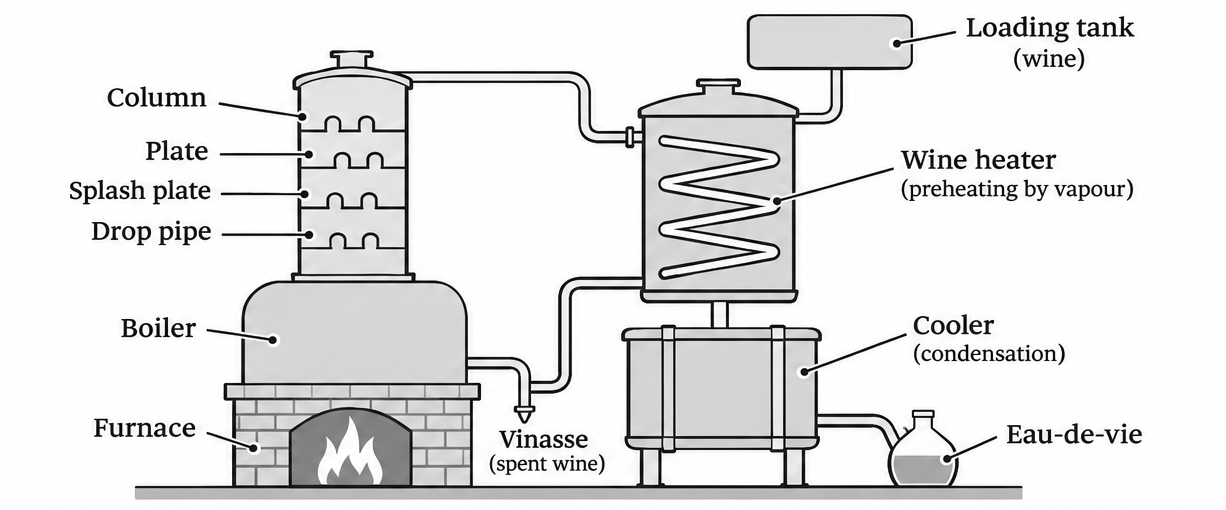
Traditional continuous Armagnac still, with wine preheating and a plate column.
Wine enters from the loading tank and is warmed in the wine heater. It then descends through the plate column, where it encounters vapour rising from the heated boiler.
The vapour passes through the wine heater before reaching a separate cooler, where it condenses into eau-de-vie. Spent wine is removed from the bottom of the system.
Simplified technical illustrations, not to scale. The Cognac réchauffe-vin is optional. Armagnac regulations also permit batch distillation, although continuous distillation is the traditional and predominant method.
Cognac: the Charentais pot still
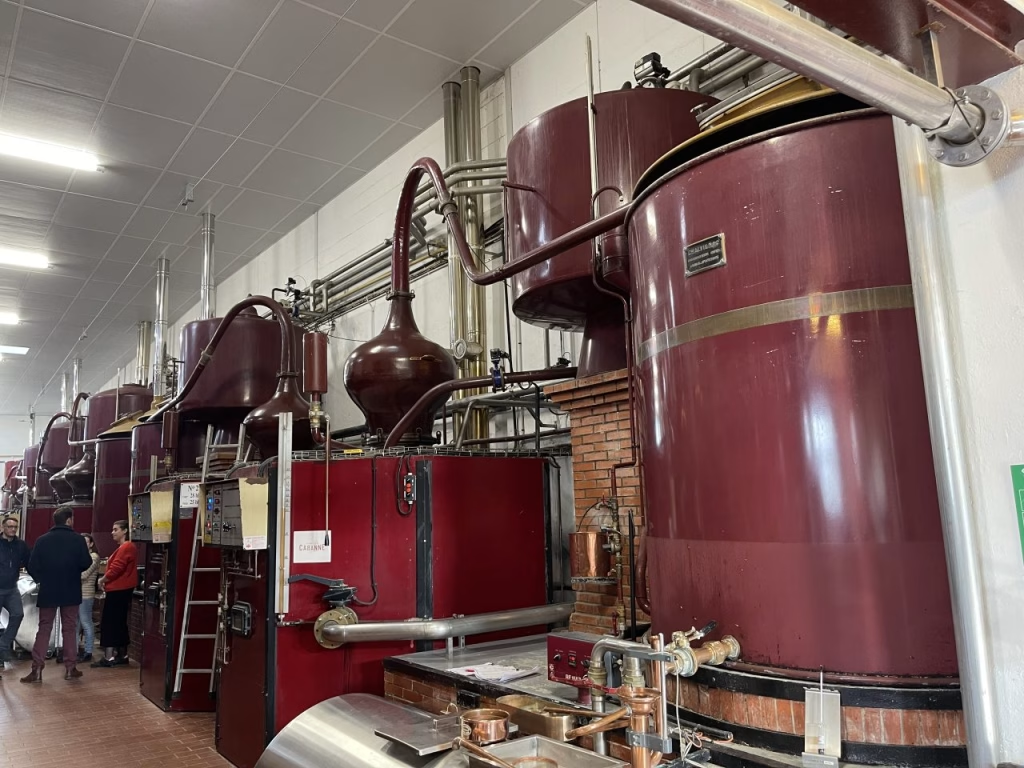
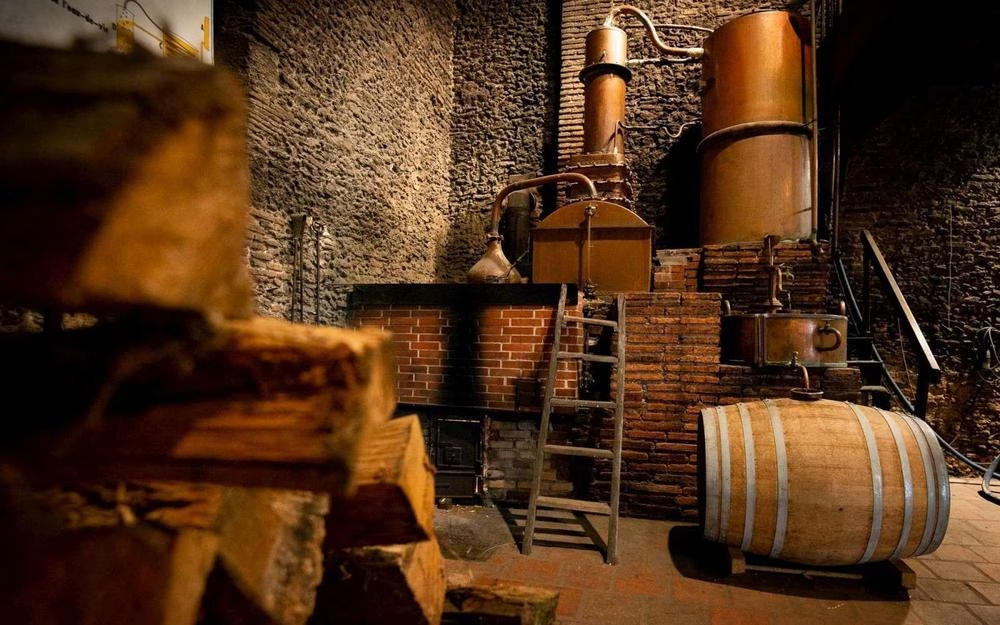
The traditional Cognac still is a copper batch still, generally heated by a direct flame, consisting of a boiler, head, swan neck, condenser and, often, a wine preheater.
Distillation takes place in two successive operations.
During the first distillation, called the première chauffe, the wine is heated and its volatile components are concentrated into a low-strength distillate called brouillis. This is commonly around 27–32% ABV, although the precise result varies.
The brouillis is then distilled again during the bonne chauffe.
During this second distillation, the distiller separates the output into fractions. The early fraction, or têtes, contains a relatively high proportion of certain highly volatile compounds. The central fraction, the cœur, is retained as the principal eau-de-vie intended for maturation. Later fractions, often grouped under secondes and queues, are handled according to the distiller’s operating method and may be recycled into subsequent distillations.
The final eau-de-vie must respect the appellation’s distillation-strength limit, conventionally expressed as a maximum of 73.7% ABV in the relevant French specification, with the European wine-spirit category imposing its own overarching rules.
The important point is that the distiller has considerable influence over the separation of fractions and the resulting aromatic profile.
A narrow heart cut may produce a different composition from a broader one. Recycling fractions changes the composition of later charges, and the behaviour of individual congeners depends on much more than their boiling points.
Armagnac: the continuous Armagnac still
The traditional alambic armagnacais operates continuously rather than through successive batch charges.
Wine enters the system and passes through a heat exchanger, where it is warmed by the vapours travelling through the condenser. The preheated wine then enters a column containing a series of plates.
As the wine descends through the column, rising vapours come into contact with the liquid. Heat and mass transfer occur at each stage, allowing alcohol and volatile compounds to move between the liquid and vapour phases.
The resulting vapours are condensed, producing an eau-de-vie that commonly leaves the still at a lower alcoholic strength than Cognac.
The Armagnac specification permits a range of 52–72.4% ABV for the principal continuous still, with traditional operation often concentrated towards the lower end.
This is not the same as saying that all Armagnac leaves the still at 52–60%, nor that every Cognac is distilled at precisely the same strength.
The actual operating conditions matter.
Unlike the multi-column industrial distillation systems used to produce very highly rectified alcohol, the traditional Armagnac still is deliberately designed to retain a substantial proportion of the wine’s aromatic character.
It is a continuous still, but not a neutral spirit still.
What about double-distilled Armagnac?
The Armagnac appellation also authorises distillation à repasse, using a batch still and successive distillations.
This is a minority practice, but it matters because it demonstrates why defining Armagnac exclusively by continuous distillation is misleading.
A double-distilled Armagnac remains Armagnac, provided it satisfies the applicable production requirements.
The same applies to the broader assumption that one distillation method automatically produces a more refined spirit than another. Equipment design, operating parameters and the composition of the wine are inseparable from the result.
Does lower distillation strength mean more flavour?
Generally, distillation at a lower alcoholic strength can allow greater retention of certain congeners. However, that doesn’t mean every aromatic compound behaves in the same way.
Volatility in a mixture of ethanol and water is complicated. A compound’s behaviour depends on its interactions with the liquid, the ethanol concentration, temperature and the design and operation of the distillation system.
Some compounds concentrate preferentially in early fractions, others in later fractions, and some show behaviour that changes as the alcoholic strength of the boiling liquid decreases.
A useful concept here is relative volatility: how readily one component transfers into the vapour compared with another under particular conditions.
Relative volatility is not constant throughout distillation. As the ethanol-water composition changes, the distribution of many aroma compounds changes with it.
This is why the familiar explanation that heads contain everything with a low boiling point and tails contain everything with a high boiling point is inadequate.
It is also why a continuous Armagnac still can produce a complex spirit without the conventional batch separation into heads, hearts and tails. The column’s design and operating conditions perform their own forms of separation.
Research on Cognac distillation has also shown that heating does more than separate compounds already present in the wine. Chemical reactions can form or degrade aroma compounds during the process.
Distillation is therefore simultaneously a separation process and a chemical transformation process.
The role of copper
Both Cognac and Armagnac rely on copper equipment, and copper contributes more than a reassuringly traditional appearance.
Copper surfaces can react with or help remove certain sulphur-containing compounds associated with undesirable aromas. Copper contact can also influence other chemical processes during distillation.
However, the amount and location of copper contact differ between still designs. Liquid-phase contact, vapour-phase contact, temperature, surface condition and cleaning practices all influence the result.
A larger copper surface area does not automatically mean better spirit. Nor does double distillation necessarily mean twice the beneficial copper interaction.
As discussed in my earlier article on copper in distillation, the chemistry is much more interesting than the familiar claim that copper simply removes sulphur.
The takeaway is that distillation architecture matters enormously, but Cognac and Armagnac are not separated by a magical line between refinement and rusticity.
They are produced using different systems, each capable of delivering a range of aromatic profiles.
Oak maturation: two traditions, many variables
Once distillation is complete, both spirits begin another complex transformation.
Oak contributes aroma compounds, interacts with the spirit and allows gradual exchanges with the surrounding environment. Evaporation changes the composition of the liquid, while chemical reactions continue during maturation.
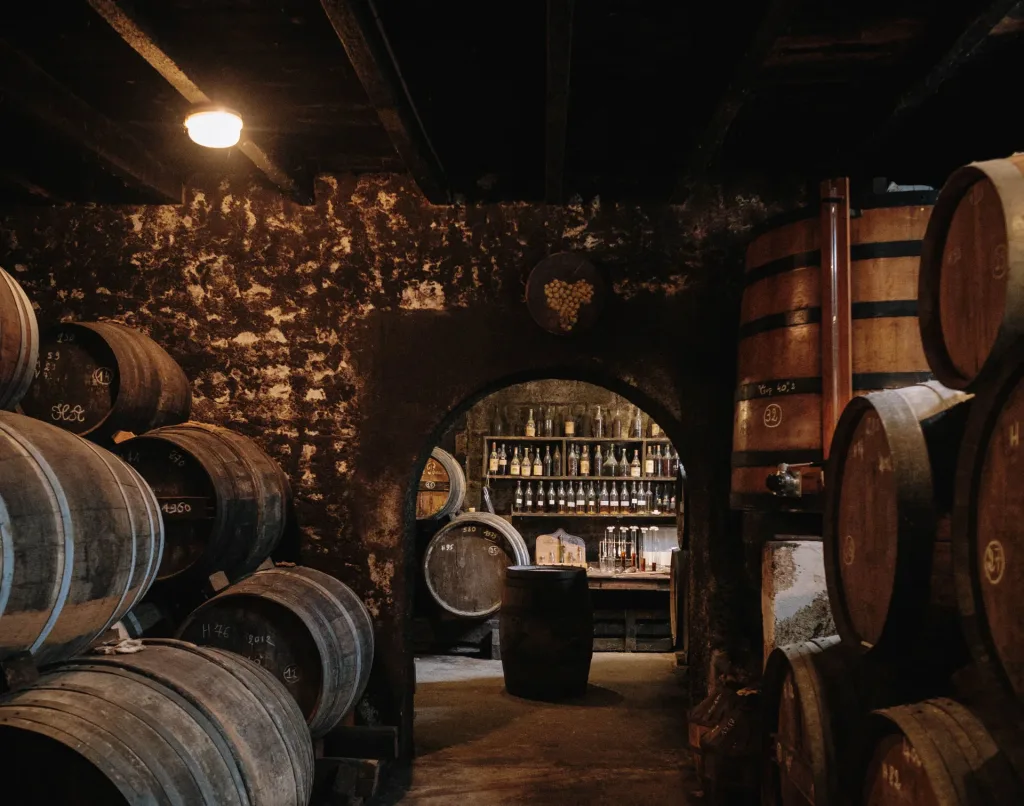
Both Cognac and aged Armagnac are traditionally matured in French oak, particularly species such as Quercus robur and Quercus petraea.
Cognac is strongly associated with oak from forests such as Limousin and Tronçais, while Armagnac has historical connections with oak from Gascony and neighbouring regions.
These geographical names can be useful, but they should not be treated as precise descriptions of wood chemistry. Species, grain, growth conditions, seasoning and heat treatment can all affect the properties of the finished cask.
Barrel size and construction
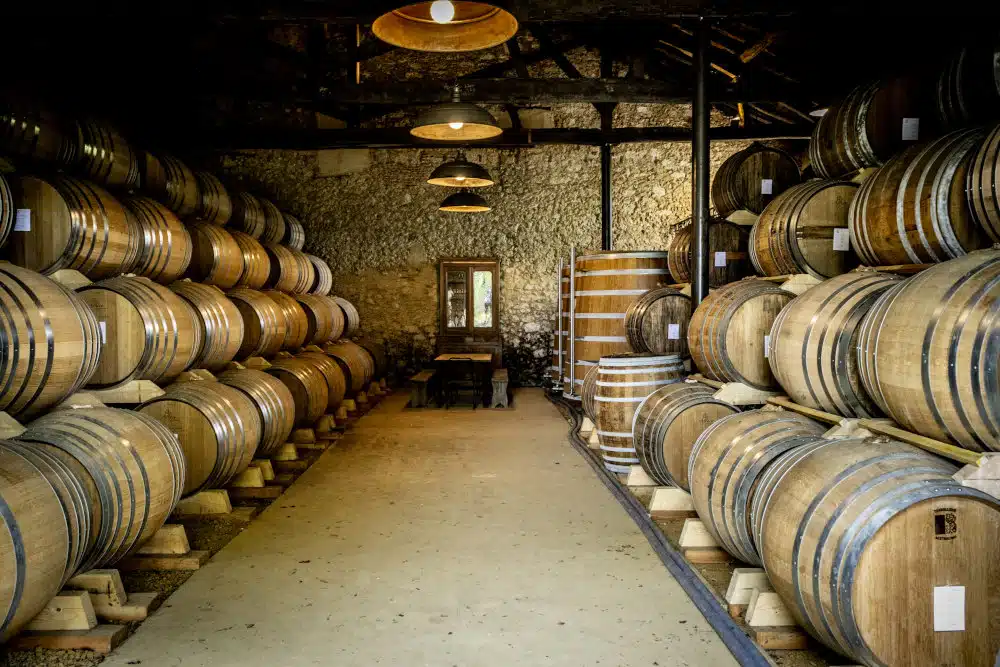
Cognac is commonly matured in casks around 350 litres, although other permitted sizes are used.
Armagnac is traditionally associated with larger pièces, often around 400 litres.
The difference can affect the ratio between the surface area of wood and the volume of spirit, but it would be simplistic to conclude that Cognac always extracts more wood compounds because its casks are smaller.
The actual cask dimensions, wood condition, previous use and warehouse environment all matter.
A heavily used 350-litre cask may contribute less extractable oak character than a newer 400-litre cask.
New oak and older casks
Both regions make use of different levels of cask activity.
A common approach is to introduce young spirit into relatively active oak before transferring it into older, less extractive casks for prolonged maturation.
This allows producers to obtain desirable wood-derived compounds while limiting the risk of excessive tannin extraction or an overpowering woody profile.
Some producers favour a gentler approach from the beginning, particularly when they want to preserve delicate fruit character over several decades.
The same underlying principles apply in both regions: extraction, evaporation and chemical transformation occur simultaneously, but their relative importance changes over time.
The objective isn’t to maximise oak extraction. It is to develop the spirit without allowing the wood to dominate.
Anyone who has tasted an excessively tannic old brandy will understand why this distinction matters.
Humid and dry cellars
Warehouse conditions influence the evolution of both spirits.
Temperature affects reaction rates, evaporation and extraction. Humidity influences the relative evaporation of water and ethanol, potentially changing the alcoholic strength of the spirit during maturation.
In humid cellars, ethanol may be lost proportionally more rapidly than water, encouraging a decline in ABV. In drier conditions, relatively greater water loss can help maintain or even increase strength.
These are tendencies rather than universal rules, and they depend on temperature, airflow, cask properties and the spirit’s composition.
A humid Cognac cellar and a humid Armagnac cellar can therefore share more in common than two cellars belonging to the same appellation but operating under very different conditions.
Rancio and very old brandies
Both Cognac and Armagnac can develop the complex characteristics collectively described as rancio.
These may include notes associated with nuts, dried fruits, mushrooms, wax, tobacco, old furniture, earthy nuances and other difficult-to-describe aromas.
As explored in my earlier article on rancio, it isn’t a single chemical compound or a characteristic that appears automatically after a predetermined number of years.
It emerges from a complicated combination of raw-material composition, maturation chemistry, oxygen exposure, evaporation and other factors.
Both appellations can produce extraordinary old eaux-de-vie. Neither has a monopoly on rancio, elegance or complexity.
Ageing regulations: similar labels, different starting points
Ageing terminology is one of the easiest places to misunderstand Cognac and Armagnac.
Both use familiar terms such as VS, VSOP and XO, but their minimum maturation requirements are not entirely identical.
| Designation | Cognac | Armagnac |
|---|---|---|
| Minimum oak maturation for the standard aged appellation | 2 years | 1 year |
| VS | 2 years | 1 year |
| VSOP | 4 years | 4 years |
| XO | 10 years | 10 years |
| Vintage bottlings | Permitted under controlled conditions | Particularly established tradition |
| Unaged or colourless appellation expression | No equivalent standard Cognac category | Blanche Armagnac |
The ageing rules are based on regulated accounting systems rather than simply reading the date on a cask and subtracting the current year.
For Cognac, the distillation campaign following a harvest runs into the next calendar year, and the official ageing accounts advance according to the regulatory calendar, with the important transition occurring on 1 April.
Armagnac also has a regulated ageing-account system, and the distinction between a harvest year, a distillation year and the actual time spent in oak remains important.
A label displaying a vintage year therefore requires some interpretation.
What does a vintage actually mean?
In both regions, a vintage refers to the harvest year of the grapes, not necessarily the calendar year in which distillation took place.
For example, wine made from grapes harvested in 1980 may be distilled in early 1981.
A 1980 vintage is not incorrect in that situation. It identifies the harvest, not the day the eau-de-vie entered the still.
Vintage Armagnacs are particularly prominent, and producers frequently provide bottling dates, allowing buyers to estimate how long the spirit remained in oak.
However, the bottling date matters. A 1975 Armagnac bottled in 2005 did not continue accumulating cask age until 2026.
It remained a spirit from the 1975 harvest, but its period of oak maturation ended when it was removed from the cask.
This is especially important for older vintages that have spent time in glass containers before bottling.
Demijohns and the end of maturation
Both regions use glass demijohns, or dames-jeannes, to preserve mature eaux-de-vie.
Once transferred from oak into glass, the spirit no longer undergoes normal cask maturation. The cellar master can, therefore, preserve an eau-de-vie that has reached a desirable balance without allowing further wood extraction to dominate.
This is particularly useful for very old stocks.
But it also means that a spirit distilled many decades ago has not necessarily spent all those decades in oak.
A harvest year tells us when the grapes were picked. It does not, by itself, establish the duration of maturation.
Additives, reduction and the myth of untouched brandy
This is where discussions of authenticity can become particularly enthusiastic.
Armagnac is sometimes presented as a more natural or less manipulated alternative to Cognac. Certain producers certainly emphasise minimal intervention, but the appellation itself does not establish a universal prohibition on all adjustments.
Both spirits are subject to regulations governing permitted production and finishing practices.
Water and alcoholic strength
Both Cognac and Armagnac may be reduced with water to reach a desired bottling strength.
Reduction can influence more than the numerical ABV. Changing the ethanol-water balance affects the solubility and sensory expression of aroma compounds, and gradual reduction may be preferred to allow the spirit to adjust.
Bottling at natural cask strength is an alternative, but it is not automatically a guarantee of superior quality.
A 46% Armagnac can be excellent. So can a 40% Cognac. Whether either would be better at a higher strength depends on the particular eau-de-vie.
That said, higher-strength bottlings can offer enthusiasts an opportunity to explore aromas and texture without the same degree of dilution.
Caramel, sugar and wood preparations
The regulations permit certain finishing adjustments, subject to defined conditions and limits.
These can include caramel for colour adjustment, sweetening for flavour balance and traditional oak-derived preparations.
In Cognac, boisé is particularly associated with oak-derived preparations used to adjust or reinforce certain characteristics.
Armagnac’s specification also explicitly permits defined finishing methods, including caramel, sweetening and an infusion of oak chips in hot water.
This is an important distinction between what is permitted and what a particular producer actually does.
A producer may choose not to use any of these methods. Another may use them within the applicable regulatory framework.
Neither the appellation name nor a romantic photograph of a centuries-old cellar tell us which approach was followed.
And the absence of an ingredient list is not proof that nothing was added.
Does Armagnac contain fewer additives than Cognac?
There is no sound basis for making that claim across the two categories as a whole.
It would require representative analytical data or sufficiently detailed production disclosures covering both industries. Individual producer practices are far too variable to justify a universal conclusion.
If transparency matters, the sensible approach is to look for producers who disclose their methods, bottling strength, reduction practices and any finishing adjustments.
That is more informative than assuming that a smaller producer must be less interventionist.
Small-scale production can be wonderful. It is not a chemical certification.
Blanche Armagnac: an important exception
One of the clearest regulatory differences is the existence of Blanche Armagnac.
Unlike the standard aged Armagnac appellation, Blanche Armagnac is not matured in oak. Instead, it undergoes a required resting period in containers that do not impart colour.
The objective is to preserve the fresh aromatic character of the distillate, including fruit and floral notes, without introducing the colour and extractive influence of wood.
This makes it particularly interesting for understanding the contribution of the base wine and distillation process.
It also offers a useful comparison with unaged grape spirits from other regions.
Cognac does not have a directly equivalent standard appellation category for a commercially released, unaged Cognac eau-de-vie.
Blanche Armagnac therefore demonstrates that the distinction between the two appellations is not limited to how they distil their wine.
Their regulations also permit different expressions of the resulting spirit.
What do Cognac and Armagnac actually taste like?
After all this discussion of grapes, stills and regulations, we arrive at the question most people probably wanted answered in the first place.
What should we expect in the glass?
The traditional Cognac profile
Cognac is often associated with floral aromas, fresh and dried fruits, citrus, vanilla, spice and, with extended maturation, increasingly complex oxidative and rancio characteristics.
Some eaux-de-vie are delicate, elegant and restrained. Others are powerful, rich, oily or intensely aromatic.
The combination of wine composition, double distillation, fraction selection and oak maturation can produce a broad range of profiles.
It is therefore misleading to describe Cognac simply as lighter or smoother than Armagnac.
The traditional Armagnac profile
Armagnac is often associated with ripe fruits, prunes, plums, spices, earthy notes, nuts and a pronounced texture.
Its traditional lower-strength distillation can contribute to a relatively congener-rich spirit, while grape variety and oak management introduce additional variation.
However, some Armagnacs are remarkably floral, fresh and delicate. Others can be quite dry, tannic or dominated by oak.
And there are Cognacs that display every bit as much power, texture and aromatic intensity as a traditional Armagnac.
Why tasting stereotypes fail
The problem with broad flavour comparisons is that we are rarely comparing like with like.
A young, reduced Cognac from a large house and a 35-year-old single-vintage Armagnac bottled at natural strength differ in far more than their appellation.
Their ages, alcoholic strengths, cask histories, blending practices and production objectives may all be different.
A fairer comparison would involve spirits of similar maturity, strength and cask influence, ideally with information about grape varieties and distillation methods.
Even then, individual producer choices may matter more than the appellation.
The most useful conclusion isn’t that Cognac tastes one way and Armagnac another. It’s that each appellation provides a different set of production possibilities.
Those possibilities overlap more than the stereotypes suggest.
Is one better than the other?
There is no objective basis for declaring one appellation superior.
Cognac has an extraordinary tradition of blending and long maturation, and some producers possess stocks capable of developing remarkable complexity over many decades.
Armagnac offers an equally fascinating range of expressions, with particularly visible traditions of vintages, estate bottlings and different grape varieties.
For enthusiasts accustomed to whisky, Armagnac’s vintage culture can feel familiar. A bottle labelled with a specific harvest year, producer and bottling date invites comparisons with single-cask or vintage Scotch whisky.
But the analogy has limits. An Armagnac vintage does not necessarily mean a single cask, just as a whisky vintage does not automatically mean one barrel.
Similarly, Cognac’s blending tradition should not be mistaken for an absence of individuality. The ability to combine different eaux-de-vie into a coherent final product is a genuine technical and sensory skill.
Personally, I find the most interesting examples in either category are those where the distillate retains its identity despite extended maturation.
Fruit, freshness, texture and balance matter more to me than an impressive age statement or an elaborate presentation box.
The same applies to whisky.
A great old Cognac is not great merely because it is old. A great Armagnac is not great merely because it comes from a small estate.
The quality has to be in the glass.
Too long, didn’t read
(Because comparing two French spirits apparently requires several thousand words, two appellation specifications and an unreasonable amount of copper.)
Cognac and Armagnac are both French wine spirits. They are made by distilling wine, usually followed by oak maturation. Their differences begin with geography and grapes, but extend through distillation, maturation and blending.
Cognac is double-distilled. Armagnac is usually distilled continuously. Armagnac can also be double-distilled, so the familiar rule has an exception. Naturally, it’s the exception that makes the subject interesting.
Armagnac’s traditional still generally produces spirit at a lower strength. This can influence congener retention, but lower distillation strength doesn’t automatically mean more flavour, more quality or more authenticity.
Both use copper, and both depend heavily on the base wine. Fermentation and wine composition matter. The still cannot perform miracles, regardless of how photogenic it looks.
Both mature in French oak. Cask activity, humidity, temperature and time influence the result. Neither appellation has discovered a way to make excessive tannins desirable simply by ageing them longer.
Cognac VS starts at two years; Armagnac VS at one. VSOP and XO follow broadly comparable minimum ages. A vintage refers to the harvest year, not necessarily the distillation year or the number of years spent in oak.
Both appellations permit certain finishing adjustments. Neither the word Cognac nor the word Armagnac guarantees that a spirit has been bottled without reduction, caramel or sweetening.
Blanche Armagnac exists. It is an unaged-in-oak expression of Armagnac, showing the character of the distillate without conventional cask maturation.
Cognac isn’t always delicate, and Armagnac isn’t always rustic. Anyone claiming otherwise probably needs to taste a few more examples. Preferably before writing a definitive guide.
And finally, neither is inherently better. The producer, the wine, the still, the cask and the decisions made along the way are considerably more useful than a competition between two geographical names.
TL;DR — Cognac vs Armagnac
Two French grape brandies. Same basic ingredients. Quite different personalities.
A deliberately simplified recap. Exceptions exist, especially in distillation methods and individual styles.
Conclusion: different traditions, shared complexity.
Cognac and Armagnac are often presented as opposites: polished versus rustic, blended versus vintage, double-distilled versus single-distilled.
Those distinctions contain elements of truth, but they are not complete descriptions of either spirit.
Both appellations encompass a remarkable range of production methods, styles and philosophies. Both depend on the transformation of a relatively simple agricultural raw material into an extraordinarily complex spirit.
Their differences are worth understanding, particularly when it comes to distillation equipment, operating strength, grape varieties and maturation practices. But those differences should help us ask better questions, not encourage us to replace tasting with stereotypes.
A label tells us where a spirit comes from and which rules governed its production. It doesn’t tell us whether the producer made good decisions, whether the cask was appropriate or whether the final result is balanced.
For that, we still need the glass.
And perhaps a second one, just to make the comparison fair.
References and further reading
Official regulations and industry resources
- Institut National de l’Origine et de la Qualité (INAO)/French Ministry of Agriculture. Cahier des charges de l’appellation d’origine contrôlée Cognac. The official production specification covering the geographical area, authorised grapes, distillation, maturation and permitted practices. Consult the official specification.
- Bureau National Interprofessionnel du Cognac (BNIC). Cognac: une origine contrôlée. An introduction to the appellation, geographical denominations and age classifications. Read the resource.
- Bureau National Interprofessionnel de l’Armagnac (BNIA). Distillation et vieillissement. A description of traditional Armagnac distillation, maturation and the role of demijohns. Read the resource.
Scientific research
- Zanghelini, G., Giampaoli, P., Athès, V., Vitu, S., Wilhelm, V., & Esteban-Decloux, M. (2024). “Charentaise distillation of cognac. Part I: Behavior of aroma compounds.” Food Research International, 178, 113977. A study of aroma-compound behaviour during traditional Cognac distillation, including the formation and degradation of volatile substances. The abstract and research summary are publicly accessible; the publisher’s full text may require access. Read the abstract.
- ‘Simulation of spirits distillation for a better understanding of volatile aroma compounds behavior: Application to Armagnac production’ (2018). Food and Bioproducts Processing, 112, 31–62. Research examining the behaviour of aroma compounds in continuous Armagnac distillation. The abstract is publicly accessible; full-text access may be restricted. Read the abstract.