Independent bottlers are usually associated with transparency. They tell us the vintage, age, cask number, cask type, outturn, and strength, sometimes even the exact dates of distillation and bottling. In some cases, an independent bottling tells you considerably more about the whisky than an official bottle from the same distillery. And then, occasionally, it tells you almost everything except where the whisky was actually distilled.
Secret Speyside. An Orkney Distillery. An Islay Single Malt. Secret Highland. Williamson. Westport. Wardhead. Burnside.
Sometimes the distillery is genuinely difficult to identify. Sometimes everybody in whisky seems to know what it is, while nobody involved in selling the bottle will actually write the name down. And sometimes what looks like an undisclosed single malt isn’t legally a single malt at all.
Welcome to one of the stranger languages of independent whisky.
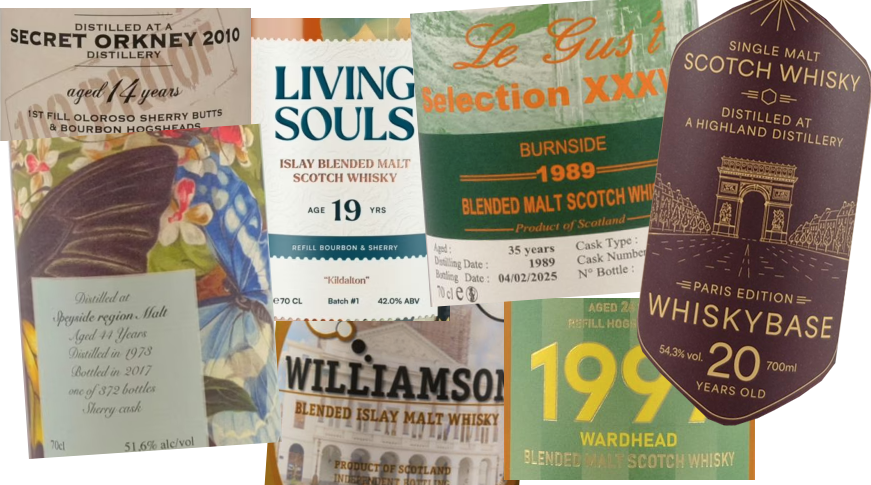
First, the distillery’s name isn’t compulsory.
This is probably the best place to start because it explains how a bottle can tell us so much while withholding the piece of information we most want.
As I explained in my article about reading independent-bottler labels, Scotch Whisky must state its legal category: Single Malt Scotch Whisky, Single Grain Scotch Whisky, Blended Malt Scotch Whisky, Blended Grain Scotch Whisky or Blended Scotch Whisky.
A Single Malt Scotch Whisky must, by definition, have been distilled at a single distillery.
It does not have to tell you which one.
The Scotch Whisky Regulations contain quite detailed rules about distillery names when they are used. A protected distillery name cannot be presented as a brand, or in a similarly prominent way, unless the whisky was wholly distilled there. The overall presentation must also not mislead consumers into thinking the whisky came from somewhere other than its true origin.
But there is no corresponding rule saying:
‘Thou shalt name the distillery.’
That leaves independent bottlers with quite a lot of room.
A label can, therefore, say:
Highland Single Malt Scotch Whisky
and stop there.
We know it came from one distillery. We know that the distillery was in the Highland region. We just don’t know which one. At least, not from those words.
Secret Highland means Highland
Let’s start with one I’ve already used in the previous article.
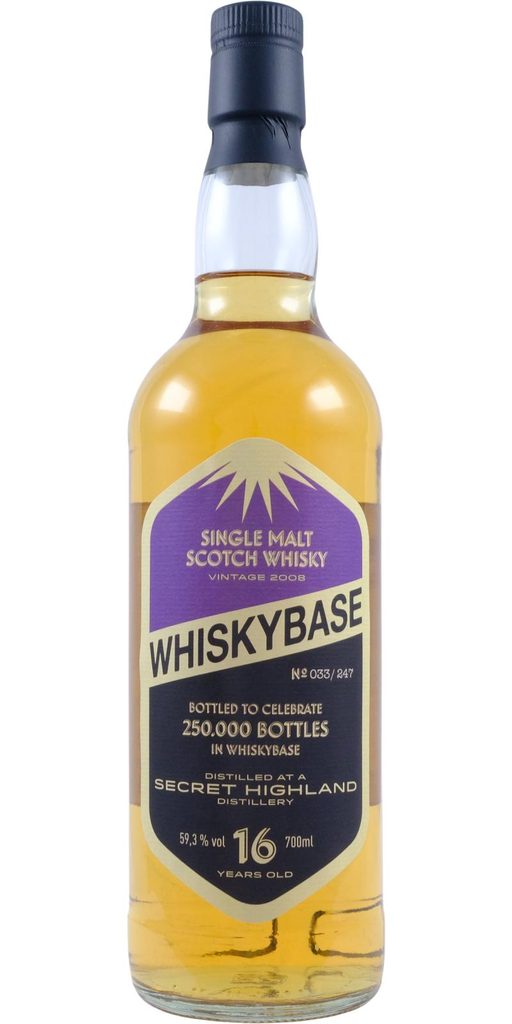
The Whiskybase Secret Highland, distilled in 2008 and bottled at 16 years old, says simply that it was:
“Distilled at a Secret Highland Distillery.”
The important word here isn’t Secret.
It’s Highland.
Highland is one of the protected Scotch whisky regions. If a whisky is presented as Highland Single Malt Scotch Whisky, the geographical part isn’t a cute hint invented by the bottler: the whisky has to have been distilled within that region.
So the label has narrowed things down.
Just not very far.
And this is the first useful rule when decoding undisclosed whisky:
Separate what the label establishes from what you think it implies.
“Highland” is information.
“The flavour reminds me of Clynelish” is evidence of a very different quality.
“A bloke on Whiskybase says it is Clynelish” is something else again.
Perhaps all three eventually point in the same direction.
But they aren’t interchangeable.
Geography can make the secret considerably smaller.
Sometimes the geographical clue is much more useful.
Take Orkney.
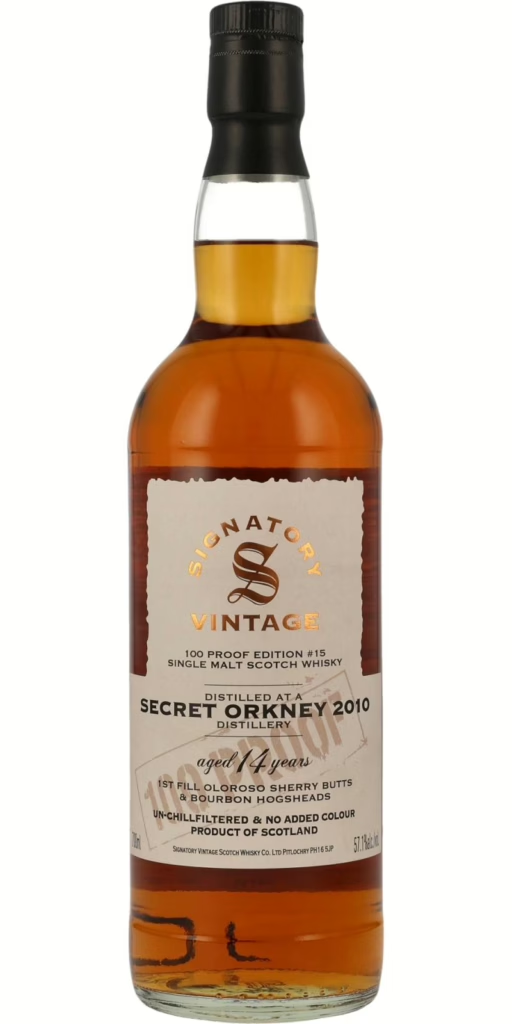
The Scotch Whisky Association’s current guidance specifically gives “Orkney Single Malt Scotch Whisky” as an acceptable geographical description for whisky distilled there.
And there aren’t exactly dozens of malt distilleries operating on Orkney.
There are two: Highland Park and Scapa.
That makes an “Orkney Single Malt” rather more entertaining to investigate than a “Highland Single Malt”.
In practice, the independent-bottling world treats many Secret Orkney, Unnamed Orkney and simply Orkney bottlings as Highland Park. The reasoning is understandable: independent Highland Park stock has circulated under undisclosed labels in significant quantities, while independent Scapa is much less common. Some bottlers also use cask references and other clues that enthusiasts associate with Highland Park stock.
But notice what happened there.
We moved from:
The label proves it was distilled on Orkney
to:
It is very probably Highland Park.
Those are not the same sentence.
Scapa exists.
Independent Scapa exists too. Gordon & Macphail release some, sometimes. Rarely, but sometimes.
So unless I have confirmation from the bottler, paperwork establishing the provenance, or some other reliable source, I would rather write:
‘This is widely understood to be Highland Park.’
than:
‘This is Highland Park.’
The difference is only a few words.
The difference in certainty is enormous.
Speyside makes a rather worse detective story.
‘Secret Speyside’ is much less cooperative.
Speyside contains enough distilleries that geography alone does very little detective work for us.
And yet undisclosed Speyside bottlings regularly acquire remarkably precise identities online.
Glenfarclas.
Macallan.
Glenlivet.
Glenrothes.
Sometimes there may be good information behind the identification. A bottler may have confirmed the source privately. The provenance may be known through the trade. Sister casks may have appeared elsewhere with more information. Cask numbers, vintages or other details may create a convincing trail.
Sometimes it is just a rumour repeated often enough to lose the word rumour.

A useful example is the number of “Secret Speyside” bottlings sold at auction or discussed by reviewers as probably Macallan. Even auction listings sometimes place them under Macallan while simultaneously acknowledging that the exact distillery has not officially been confirmed.
That distinction is worth preserving.
If the bottle says Secret Speyside, then Secret Speyside is what the bottle establishes.
Everything after that needs evidence.
Otherwise whisky identification becomes a very entertaining game of Chinese whispers.
Why hide the name in the first place?
This is where things become less mysterious and more commercial.
A distillery owner may be perfectly happy to sell stock without being equally happy to have somebody else put its valuable brand name on the resulting bottle.
Those are two separate things.
The independent bottler owns – or has acquired – the whisky.
That doesn’t necessarily mean it has acquired unrestricted rights to use the distillery’s name in marketing it.
Contracts can restrict the use of the name when stock is sold. Brand owners may want control over how their distillery is presented, particularly when they have spent decades and considerable amounts of money building that name.
That concern isn’t imaginary.
The Scotch Whisky Association’s guidance on Regulation 9 explains that the rules on distillery names were introduced partly because consumers had bought single malts under brand names they mistakenly believed were the names of actual distilleries.
And from the distillery owner’s perspective, an independent bottling creates another problem.
It has no control over the final product.
The independent bottler may put the spirit into a cask the distillery would never use, leave it there considerably longer than the distillery would, bottle it at 65%, release an unusually sulphury single cask, or simply produce something that bears very little resemblance to the official house style.
That can be precisely why we find independent bottlings interesting.
It can also explain why a brand owner might not be desperate to have its name printed across the front.
I would be careful, however, about assuming the motivation behind every undisclosed cask.
Unless the parties tell us why the name cannot be used, all we really know is that it isn’t being used.
Sometimes the secret gets a new name.
This is where the whisky vocabulary becomes rather entertaining.
Instead of ‘Secret Something’, some parcels of whisky circulate under names that enthusiasts learn to associate with particular distilleries.
Williamson is probably one of the best-known examples.


Williamson is associated with Laphroaig and takes its name from Bessie Williamson, one of the most important figures in the distillery’s history.
Westport is associated with Glenmorangie. Wardhead with Glenfiddich. Burnside with Balvenie. Aldunie with Kininvie.
You will regularly find retailers, auction houses, reviewers and whisky databases decoding those names for you.
But here we need another warning.
These names are not a second official system of Scotch whisky distillery names.
There isn’t an appendix to the Scotch Whisky Regulations saying:
Westport = Glenmorangie
Williamson = Laphroaig
Burnside = Balvenie
They are trade names, conventions and identifiers whose meaning comes from their use and provenance rather than from the five legal Scotch whisky categories.
And some of them introduce another complication.
Bring me a teaspoon
‘Teaspooning’ is one of those wonderfully evocative whisky terms that creates an immediate mental picture. Someone takes a cask of single malt, ceremoniously adds a teaspoon of whisky from another distillery, and voilà: the original single malt has disappeared.
Legally, the basic idea is sound.
The Scotch Whisky Regulations define Single Malt Scotch Whisky as whisky distilled at one distillery from water and malted barley in pot stills. Blended Malt Scotch Whisky is a blend of two or more Single Malt Scotch Whiskies distilled at more than one distillery.
So if malt whisky from another distillery really is added, however tiny the proportion, the resulting whisky is no longer Single Malt Scotch Whisky. It becomes Blended Malt Scotch Whisky.
There is no legal minimum percentage that the second malt must contribute before the first one suddenly stops being a single malt.
Hence the teaspoon.
But I would be cautious about taking the name too literally. ‘Teaspooned’ is trade shorthand. It does not necessarily establish that somebody physically stood over each individual cask with a teaspoon. What matters legally is that whisky from more than one distillery has been combined.
And that creates a wonderfully strange category of bottling.
A cask can be described as a single cask while the whisky inside it is legally a blended malt.
Those statements answer two different questions.
We’ve already seen exactly that with my Swell de Spirits Secret Islay.
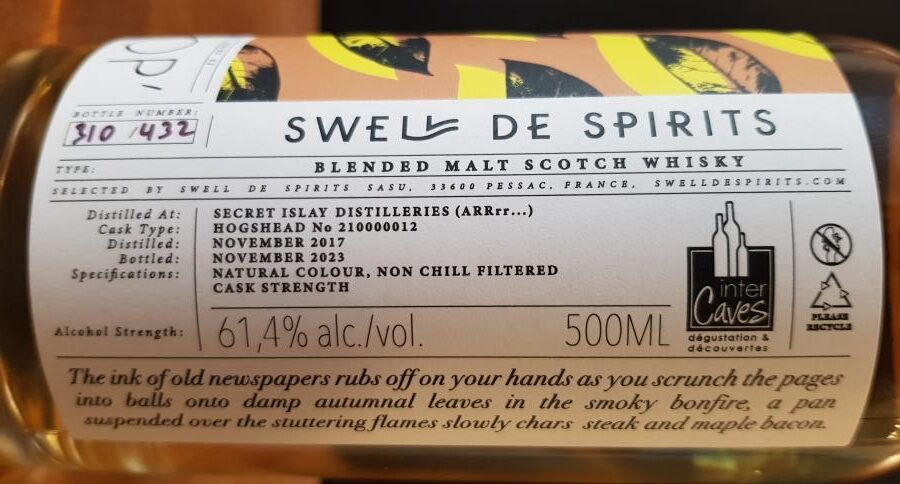
It came from a single hogshead, with an outturn of 432 bottles.
Yet its category is:
Blended Malt Scotch Whisky.
According to the bottler, the whisky had been teaspooned.
One cask.
More than one distillery’s malt.
Single cask.
Blended malt.
Whisky terminology is fun.
Why teaspoon it?
The practical advantage is obvious. Once another malt has been added, the whisky can no longer legally be sold as Single Malt Scotch Whisky from the original distillery. That creates an additional layer of protection between the liquid and the distillery brand.
The whisky can still be sold and bottled independently, but it cannot simply appear as, say, a Glenmorangie Single Malt Scotch Whisky. Instead, teaspooned Glenmorangie stock is widely encountered under the name Westport.
Similarly, the trade commonly associates Wardhead with Glenfiddich and Burnside with Balvenie.
Again, however, I would keep the wording careful.
If I know from reliable provenance that a particular Westport is teaspooned Glenmorangie, I can say so. If I know only that Westport generally means teaspooned Glenmorangie, that is what I should say. A trade convention isn’t magically transformed into provenance because everybody recognises it.
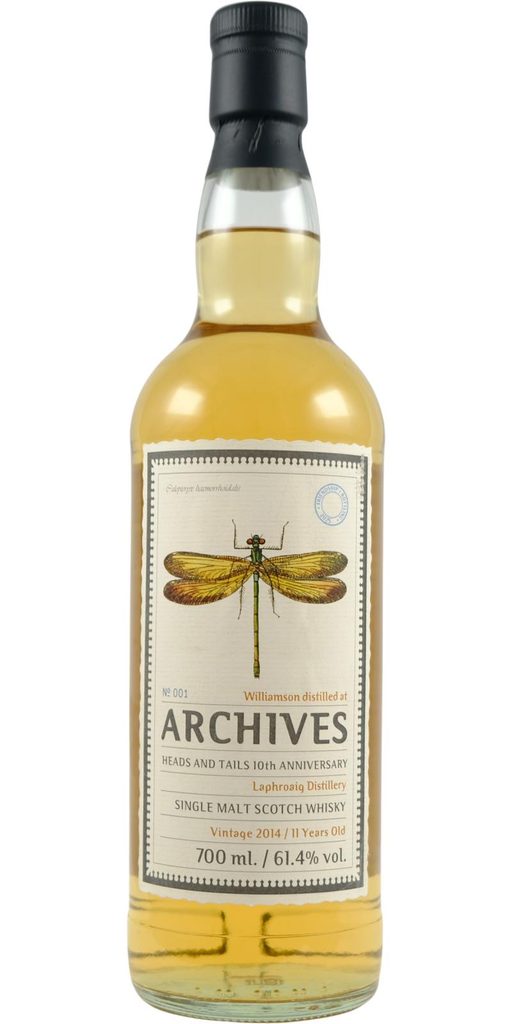
However, sometimes you both have the codename and the real distillery name. Like this Williamson distilled at Laphroaig bottled by Archives. Why could they write both on the label? Because it was written like that on the cask they bought.
Lovely dram, by the way, which had great success when we poured it at Whisky Live Paris. But I disgress, sorry.
Undisclosed and teaspooned are not synonyms
This is probably the distinction I most want to make in this article.
Imagine two bottles.
Bottle A says: Secret Speyside Single Malt Scotch Whisky.
Bottle B says: Westport Blended Malt Scotch Whisky.
Both may be described casually as ‘undisclosed whisky’.
But legally, they tell us very different things.
Bottle A is still a single malt. Whatever the hidden distillery is, all the whisky came from that one distillery. The bottler simply isn’t telling us its name.
Bottle B is a blended malt. It contains malt whisky from more than one distillery. If the usual explanation for Westport is correct, one of those malts overwhelmingly dominates the composition – but that does not change the category.
This is why I dislike using teaspooned as a generic explanation whenever a distillery’s name is missing.
Sometimes the whisky is undisclosed because the bottler cannot or does not want to name the distillery.
Sometimes it has actually been blended with another malt.
The label tells you which legal category you’re dealing with.
Read that before reading the rumours.
Then there are names that aren’t really secrets at all.
There is another category that can look similar but shouldn’t automatically be mixed with undisclosed whisky.
Some distilleries or spirit styles simply appear under alternative names.
Macduff is a good example.
The distillery is Macduff, but its official single malt has historically appeared as Glen Deveron and now The Deveron. Independent bottlers, meanwhile, commonly use Macduff.
Nobody is really hiding Macduff there.
It is a naming and branding history.
Similarly, names associated with particular production styles can sometimes look like secret-distillery aliases when they actually identify a type of spirit made at a known distillery.
This is why a giant internet list headed SECRET WHISKY CODES can be more misleading than helpful.
Not every alternative name exists for the same reason.
Some indicate teaspooned whisky.
Some are contractual aliases.
Some are brand names.
Some identify production styles.
Some are merely bottler inventions.
And some associations are simply enthusiast assumptions repeated from one website to another.
The interesting question isn’t just:
‘What distillery does this name mean?’
It is:
‘Why is this name being used?’
Can the cask number reveal it?
Sometimes people go further.
The distillery isn’t named, but the vintage matches.
The cask number looks familiar.
The parcel resembles another bottling whose origin was disclosed.
The label contains a suspicious drawing.
The bottler gives a wink.
Someone notices that the initials spell something.
At this point whisky enthusiasts turn into detectives who have been given too much coffee.
And occasionally it works.
Cask-number sequences and parcel references can provide useful provenance clues, especially when related casks have appeared through other bottlers.
But they are clues.
Unless you have documentary provenance connecting a particular numbering system with a distillery, a familiar-looking cask number does not become proof merely because it fits your theory.
The same applies to label jokes.
Independent bottlers know perfectly well that enthusiasts enjoy this game.
Some labels practically invite it.
That still doesn’t turn a wink into a certificate of origin.
What about the taste?
Surely you can just taste it?
Sometimes you can make a very good guess.
A heavily peated Islay whisky with medicinal smoke might narrow the field considerably.
A lightly peated, heathery Orkney malt might make one distillery seem much more likely than the other.
A waxy Highland whisky might immediately send enthusiasts towards a familiar name.
But there are at least two problems.
The first is that distillery character isn’t a fingerprint.
Cask influence can transform spirit dramatically. Fermentation and production regimes change. Different vintages behave differently. An independent bottler may present a distillery in a way that bears little resemblance to its official releases.
The second problem is expectation.
If somebody tells me a Secret Highland is ‘obviously Clynelish’ before I taste it, suddenly every trace of wax becomes very persuasive.
Blind, perhaps I would have said something completely different.
So tasting can support identification.
I would be very reluctant to let it establish one.
The hierarchy I actually use
After writing the previous article about labels, I don’t think a rigid hierarchy of evidence is particularly useful. Different sources answer different questions.
But for undisclosed whisky, I do think it helps to separate confirmation from clues. If the bottler or distillery explicitly confirms the origin, that is strong evidence. If reliable documentation or provenance identifies the source, likewise.
If the legal category and geographical description narrow the possibilities, those are facts established by the label.
Then come trade names with well-established associations, cask references, sister casks, retailer information and other provenance clues.
And finally, there are flavours, label hints, rumours and the collective detective work of the whisky internet.
Those last things can be useful.
They can even be right.
They just shouldn’t quietly change the grammatical tense from:
‘This is believed to be…’
to:
‘This is…’
somewhere between one review and the next.
How I read an undisclosed bottle
So when I encounter one now, I start with the boring information.
Because boring information is usually reliable information.
What is the legal category?
If it says Single Malt Scotch Whisky, I know it came from one distillery.
If it says Blended Malt Scotch Whisky, I know malt whisky from more than one distillery is involved.
Does it make a geographical claim?
Highland, Speyside and Islay can meaningfully narrow the origin. Something like Orkney can narrow it even further.
Is the distillery actually undisclosed, or is an alternative/trade name being used?
Those aren’t necessarily the same thing.
Has the bottler explained the provenance?
If so, great.
Is the identification documented elsewhere?
A related cask, bottler statement or reliable trade source may settle the question.
And only then:
What does everyone think it is?
That last question is usually the most fun.
It just isn’t the one I would ask first.
The mystery is part of the appeal.
There is something slightly absurd about all this.
A bottler can sell you a whisky and tell you that it was distilled in 1998, matured for 26 years in cask number 1234, finished for eleven months in a first-fill oloroso hogshead, bottled at 54.7%, yielded 247 bottles, was neither coloured nor chill filtered…
…but apparently the name of the building where it was made is classified information.
Of course, sometimes the secret is barely a secret at all.
‘Orkney Single Malt’ may be accompanied by enough nudges and winks that everybody buying it knows what they are expected to think.
‘Secret Highland’ with candles and cats are enough nudges and winks that everybody buying it knows it comes from veeeery close to Brora.
A trade name such as Westport may communicate more to an experienced whisky drinker than ‘Secret Highland’ ever could.
And perhaps that is why undisclosed whisky has developed a language of its own.
It lets the industry say something without quite saying it.
The distillery’s owner protects its name.
The independent bottler gets interesting stock to bottle.
The enthusiast gets a mystery to solve.
Everybody wins.
Well, except perhaps the person who has just bought a Secret Speyside and is now staring at a list of fifty distilleries.
Too long, didn’t read
(Yes, apparently, I’m doing these now. My articles are getting as long as my questions. I really need to be able to get back on the booze.)
There are several different things hiding behind what we casually call undisclosed whisky.
A Secret Highland Single Malt is still a single malt from one distillery. The name of that distillery simply isn’t being given.
A Secret Speyside Single Malt tells you the same thing while narrowing the geography to Speyside.
An Orkney Single Malt narrows the possibilities dramatically, but it does not, by itself, print ‘Highland Park’ on the label.
A whisky sold under a trade name such as Westport, Williamson, Wardhead or Burnside may carry an association well understood within the whisky trade, but that association should not automatically be treated as documentary proof for every bottle bearing the name.
And a teaspooned whisky is something different again. If malt from another distillery has actually been added, the result cannot legally remain Single Malt Scotch Whisky. It becomes Blended Malt Scotch Whisky, even if the amount of the second malt is tiny.
So the easiest way to avoid getting lost is also the least exciting one:
Read the legal category first.
Then read the geography.
Then look at what the bottler actually claims.
Only after that should you start decoding cask numbers, aliases, label jokes, rumours and tasting notes.
Because with undisclosed whisky, there is an important difference between knowing, having good reason to believe, and everybody saying the same thing.
Sometimes the distillery really is secret.
Sometimes it is hiding in plain sight.
And sometimes we whisky enthusiasts are simply very good at turning a rumour into a fact by repeating it often enough.
Which, admittedly, is much more fun than just reading the label.