
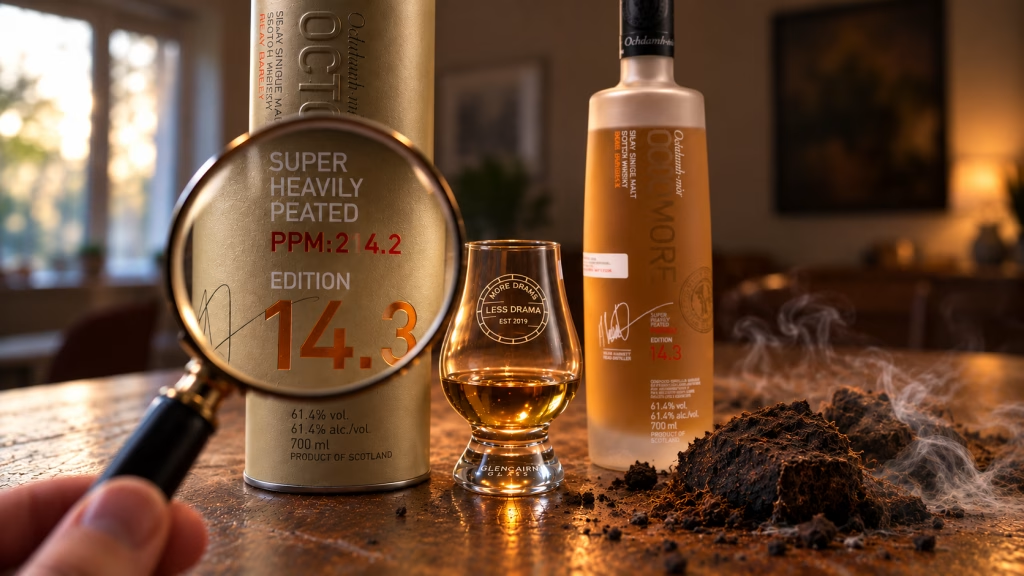
Phenols, laboratory measurements and why a whisky labelled 100 ppm isn’t necessarily twice as smoky as one labelled 50 ppm.
Whisky enthusiasts love numbers. Age statements, alcohol percentages, distillation years, cask numbers, bottle counts… Give us a number and we’ll find a way to compare it with another one. And when it comes to peated whisky, there’s one number that seems particularly irresistible: PPM.
Ardbeg at around 50 ppm? Very peaty. Octomore at more than 200 ppm? Surely four times as smoky. And Octomore 08.3, with its extraordinary 309.1 ppm? You might reasonably expect to smell it from the other side of the room.
Except that’s not quite how it works.
PPM is a legitimate analytical measurement, useful to maltsters and distillers. But taking a number measured at one stage of whisky production, printing it on a bottle several years later and interpreting it as a measurement of what our nose and palate will experience is rather misleading.
I’ve already written about what peat is, how it forms, how it is used during malting and how its smoke finds its way into whisky. This time, we’ll concentrate on the number itself.
What exactly does PPM measure? How much of that smoky material survives distillation and maturation? And why doesn’t a whisky labelled 100 ppm necessarily taste twice as smoky as one labelled 50 ppm?
What does PPM actually mean?
PPM stands for parts per million. It’s a way of expressing concentration, not a measurement of how intensely something smells or tastes.
In the context of peated malted barley, a specification of 50 ppm generally means a measured phenolic concentration equivalent to 50 milligrams per kilogram of malt, according to the analytical method used.
Peat smoke contains numerous chemical compounds, including a family called phenols. Some of these contribute the medicinal, smoky, tarry, ashy and other characteristics we associate with peated whisky.
But there’s an important distinction: the PPM figure most commonly advertised for a whisky refers to its malted barley, not the finished spirit.
If a whisky is advertised at 50 ppm, that usually means the malt used to produce it had a measured phenolic concentration of 50 ppm before mashing. It doesn’t mean the whisky in your glass contains 50 milligrams of phenols per kilogram of liquid.
Between the malt and your glass lie mashing, fermentation, distillation and several years of maturation. Each of these stages can change the composition and concentration of phenolic compounds.
And there’s another complication. Even when we’re measuring the malt, the result isn’t necessarily as straightforward as it appears.
Measuring phenols: not all methods are equal.
You might reasonably assume that measuring phenols is simply a matter of putting some malt into a laboratory instrument and reading the result.
Unfortunately, even the measurement itself has a rather complicated history.
In 1968, C. Macfarlane published a method for determining phenols in malt using solvent extraction followed by a chemical colour reaction involving 4-aminophenazone. The intensity of the resulting colour could be measured and used to estimate the concentration of phenols.
This colourimetric method was relatively straightforward and useful for industrial quality control. Maltsters needed a practical way to deliver batches of peated malt meeting particular specifications, and distillers needed some degree of consistency.
But the method had limitations.
Not every phenolic compound reacts equally with the reagent, and some may contribute little or nothing to the result. The measurement therefore depends on the chemical reaction used and the compounds to which it responds.
In 1977, Graham Bathgate and A. G. Taylor investigated the qualitative and quantitative measurement of peat smoke on distillers’ malt, highlighting the importance of analytical methodology. Bathgate later revisited the subject in his 2019 review of malt and wort processing.
Modern techniques, particularly high-performance liquid chromatography (HPLC), allow analysts to separate individual compounds and measure them more selectively. Gas chromatography, often coupled with mass spectrometry, is another valuable technique for analysing volatile phenolic compounds.
These methods can provide much more detailed information than a simple colour reaction. But that doesn’t mean every laboratory necessarily reports an identical total. Sample preparation, calibration, the compounds selected for analysis and the way their concentrations are combined can all influence the reported figure.
Strictly speaking, total phenols can therefore mean a method-defined total rather than an exhaustive measurement of every phenolic compound present.
And there’s a particularly revealing real-world example.
St. Kilian: when 54 ppm becomes 80 ppm
German distillery St. Kilian provides an excellent illustration of why the analytical method matters.
Until mid-2023, its peated malt from Glenesk Maltings in Scotland was analysed using a colorimetric method. The result was consistently approximately 54 ppm.
The analytical method was subsequently changed to HPLC, and the reported concentration became approximately 80 ppm.
That’s an increase of about 48%.
Had the malt suddenly become almost 50% more heavily peated? Had the supplier changed its production process? Would the resulting whisky now taste nearly 50% smokier?
No. According to St. Kilian, the malt supply remained the same. The difference came from the analytical method, with HPLC detecting phenolic compounds that the previous colorimetric procedure had not adequately accounted for.
The malt hadn’t changed. The measurement had.
Same peated malt. Different measurement.
St. Kilian’s reported phenol concentrations before and after a change in analytical method
This doesn’t mean that PPM figures are arbitrary, nor that HPLC is unreliable. More selective analytical techniques can provide a better characterisation of the compounds present.
But it does mean that comparing two PPM figures without knowing how they were obtained can be misleading.
Sometimes the biggest difference between two PPM figures is the laboratory.
From malt to new make: where do the phenols go?
Now imagine two distilleries receiving peated malt with exactly the same measured phenolic concentration: 50 ppm, using the same analytical method.
Would their new make spirits contain the same amount of phenolic compounds?
Not necessarily. In fact, there are several reasons why they might be quite different.
During mashing, the grist is mixed with hot water to extract fermentable sugars and other soluble compounds. Some phenolic compounds pass into the wort, while others remain associated with the grain and are removed with the draff.
Their transfer depends on their individual chemical properties, their association with components of the malt and the conditions used during mashing.
This is already enough to make the relationship between malt PPM and wort phenol concentration less than straightforward.
Fermentation introduces further changes. Yeast transforms sugars into ethanol and carbon dioxide, but it also produces numerous aroma compounds, including esters and higher alcohols.
Some phenolic compounds may undergo transformations, while the newly produced fermentation aromas alter the overall sensory profile. A spirit containing a substantial concentration of smoky compounds may nevertheless smell noticeably fruity, depending on the balance of other aroma molecules.
And then comes distillation.
Why the spirit cut matters
Distillation isn’t simply a process of separating substances according to their individual boiling points. In a complex mixture of water, ethanol and numerous other compounds, volatility depends on interactions between molecules and the changing composition of the liquid.
Different phenolic compounds therefore behave differently during distillation.
The still’s geometry, heating regime, reflux and condensation system all influence the composition of the vapour and the resulting spirit. But one particularly important decision is where the distiller makes the cuts.
The foreshots, hearts and feints don’t contain identical proportions of aroma compounds. Many heavier smoky compounds become more prominent towards the later stages of the spirit run, although their precise distribution varies.
A distiller who extends the heart cut may retain more of certain phenolic compounds, but also risks including heavier or less desirable flavours. A narrower cut may produce a cleaner spirit while leaving more of those compounds behind.
This isn’t simply a question of capturing as much smoke as possible. It’s a question of selecting the combination of aromas that best suits the desired spirit character.
Consequently, two distilleries using the same 50 ppm malt can produce new make spirits with very different concentrations and proportions of phenolic compounds.
One might be intensely medicinal, another more ashy or earthy, and a third surprisingly restrained.
The starting number is identical. The result isn’t.
Can we calculate how much survives?
You may have encountered figures suggesting that a particular percentage of phenols survives mashing, distillation or maturation.
These can be useful when they come from clearly defined experiments, but we need to be careful about treating them as universal conversion factors.
For example, St. Kilian suggests that around one third, or sometimes less, of the original phenolic content of malt may ultimately be found in mature whisky. This is a useful industry estimate, not a fixed law of whisky production.
For this article, I couldn’t establish a publicly documented, controlled dataset following the same production batch from malt through new make and successive maturation stages, using comparable analytical methods at every point.
Without such data, it would be misleading to construct a neat chart showing that a whisky starts at 50 ppm, falls to a precise concentration after distillation, and then declines predictably year after year.
The broad principle is well supported: the phenolic profile changes during production, and not everything measured in the malt reaches the bottle.
The precise conversion, however, depends on the whisky and on what is being measured.
From peated malt to finished whisky
What happens to phenolic compounds along the way?
Not all phenols smell the same
There’s another problem with treating PPM as a measure of smokiness: phenols aren’t one single substance with one recognisable smell.
They’re a large family of chemical compounds, and different members can have quite different aromatic characteristics.
Phenol itself is associated with medicinal and disinfectant-like aromas. Cresols, which are methyl-substituted phenols, can contribute medicinal, tarry and smoky characteristics. Guaiacol, also known as 2-methoxyphenol, is associated with smoke, burnt wood and related aromas.
Other substituted phenols and methoxyphenols can contribute spicy, clove-like, woody or additional smoky characteristics.
These descriptions aren’t absolute, of course. The aroma of a compound depends on its concentration and the other substances present.
But they illustrate why two whiskies with the same measured total phenolic concentration might smell very different.
One might remind you of antiseptic and sticking plasters. Another of a dying bonfire. A third of smoked meat, damp earth or wood ash.
A single total PPM figure tells us very little about the proportions of individual compounds responsible for those differences.
And those proportions matter enormously.
Not all phenols smell the same
Different compounds. Different aromatic contributions.
Odour thresholds and aromatic impact
Not every aroma molecule is equally easy to smell.
An odour threshold is the concentration at which a particular compound becomes detectable under specified conditions. Some compounds can be perceived at extremely low concentrations, while others require substantially more.
Researchers often use odour activity values (OAVs) to estimate the potential aromatic importance of individual compounds.
An OAV is calculated by dividing a compound’s concentration by its odour threshold. A value above one suggests that the compound may contribute to aroma, although this is only an approximation.
Importantly, odour thresholds depend on the medium in which they’re measured. A molecule dissolved in water doesn’t necessarily behave the same way in a whisky containing ethanol and hundreds of other compounds.
And even if we know the concentration and threshold of every individual molecule, we still haven’t completely explained what the whisky will smell like.
Aromas interact. Some reinforce one another, while others mask or modify the perception of different compounds.
Which brings us to the central question.
Why 100 ppm isn’t twice as smoky as 50 ppm
Suppose Whisky A is made using malt at 50 ppm and Whisky B using malt at 100 ppm.
It would be tempting to conclude that Whisky B should taste twice as smoky.
For that to work, several assumptions would have to be true. Both distilleries would need to retain the same proportion of phenolic compounds during production. Their phenolic mixtures would need to have similar compositions. Maturation would need to affect them in comparable ways. And our perception of smokiness would need to increase proportionally with concentration.
None of those assumptions is guaranteed.
Human sensory perception doesn’t generally operate like a laboratory instrument. Doubling the concentration of an aroma compound doesn’t necessarily double its perceived intensity.
For many sensory stimuli, the relationship between concentration and perceived intensity is non-linear. Different compounds can follow different concentration – intensity relationships, and the effects of mixtures can be more complicated still.
Whisky introduces additional variables. Ethanol concentration, sweetness, fruitiness, wood-derived aromas and other volatile compounds can all influence the perception of peatiness.
This isn’t merely theoretical.
What the research found
In 2019, Veronika Mall and Peter Schieberle published a study investigating the contribution of phenolic compounds to the peaty aroma of Scotch whiskies from Islay.
The researchers examined ten whiskies, combining sensory assessment with chemical analysis of phenolic aroma compounds.
Their results confirmed that phenolic compounds play a major role in producing the characteristic peaty aroma.
But there was an important complication.
The measured concentrations of those compounds, and even their calculated odour activity values, did not correlate well with the perceived intensity of peatiness.
That’s a particularly revealing finding.
Even when researchers measured phenolic compounds in actual whiskies, rather than relying on the original malt specifications, the relationship between chemical concentration and perceived smokiness remained complicated.
The study doesn’t mean phenol concentrations are irrelevant. It means that concentration alone isn’t sufficient to predict the sensory result.
Related research by Mall and Schieberle identified several phenolic compounds contributing to the characteristic aroma of peated whisky. Some individual compounds exhibited high odour activity values, demonstrating that their aromatic impact could be considerable even when their concentrations weren’t particularly large.
In other words, a whisky’s smoky character depends not only on how much phenolic material it contains, but also on which compounds are present and how they interact.
PPM measures concentration. It doesn’t measure the intensity of your sensory experience.
Octomore: when PPM becomes spectacular.
Few whiskies illustrate the limitations of PPM quite as dramatically as Octomore.
Produced at Bruichladdich, Octomore has made exceptionally high phenolic specifications part of its identity. The numbers are frequently spectacular.
Octomore 14.3, for example, was produced using malt measured at 214.2 ppm. And Octomore 08.3, released in 2017, reached an extraordinary 309.1 ppm.
For comparison, many heavily peated Islay whiskies use malt specified at around 40–55 ppm, although the figures vary between distilleries and expressions.
On paper, Octomore appears to inhabit another universe.
Yet anyone who has tasted several Octomore releases will know that they aren’t simply progressively more aggressive versions of a conventional peated Islay malt. Some can be remarkably fruity, balanced or elegant despite their extraordinary starting phenolic concentrations.
That’s part of what makes Octomore so interesting.
Bruichladdich is explicit that its published Octomore PPM figures refer to the malted barley, not the bottled whisky. The distillery also emphasises that the resulting character depends on far more than the initial phenolic specification.
And Octomore releases can differ in barley provenance, fermentation, distillation, maturation and cask selection.
Take Octomore 08.3, with its 309.1 ppm malt specification. It was matured for five years in a combination of ex-bourbon and European wine casks. Those maturation choices contribute flavours and aromas that interact with the spirit’s smoky character.
The whisky’s exceptionally high malt PPM figure tells us that the barley was very heavily peated. It doesn’t tell us the concentration of phenolic compounds in the finished whisky, nor how those compounds will be perceived alongside everything else.
It also doesn’t establish that Octomore 08.3 must smell six times as smoky as a whisky produced using 50 ppm malt.
The numbers describe the raw material, not a linear sensory scale.
And there’s a further point worth remembering: the differences between Octomore releases aren’t necessarily determined by their malt PPM specifications. An expression with a lower reported number may seem more immediately smoky to a particular drinker than another with a higher one.
That doesn’t invalidate the measurements. It simply demonstrates that the finished whisky is more complicated than the starting specification.
When PPM actually refers to the whisky.
Most producers quote the phenolic concentration of the malt, but a few have taken a different approach.
Rather than describing the barley used to produce the whisky, they’ve reported measurements associated with the finished liquid.
This is particularly interesting because it removes one major source of ambiguity.
anCnoc: putting the number on the bottle
In 2014, anCnoc introduced its Peaty Collection, including expressions such as Rutter, Flaughter and Tushkar.
The range was unusual because its PPM figures were intended to describe the phenolic content of the whisky rather than simply advertise the peating level of the malt.
The idea was to give consumers an indication of the relative peatiness of the expressions.
It’s an interesting approach, particularly within a range where the measurements are intended to be compared using a consistent methodology.
But it doesn’t eliminate the underlying sensory problem. Two whiskies with different measured phenolic concentrations can still have different aromatic balances, and the one with the higher number won’t necessarily seem proportionally smokier.
Ailsa Bay: measuring the liquid
Ailsa Bay also adopted an unusual approach to quantifying the character of its whisky.
Its first single malt, released in 2016, was reported at 21 ppm in the finished whisky. The later Release 1.2 Sweet Smoke increased this to 22 ppm.
The distillery also introduced a separate measurement intended to describe sweetness, expressed as SPPM.
Whether sweetness can be reduced to a similarly convenient single figure is another interesting question, but that’s a subject for another day.
What’s relevant here is that Ailsa Bay was reporting a phenolic concentration associated with the whisky itself, rather than simply the malt specification.
Bimber: 14.4 ppm in the bottle
In 2022, London’s Bimber Distillery released its first peated single malt.
The whisky was assembled from four ex-bourbon casks containing spirit distilled in May 2019 and bottled at 54.1% ABV.
The distillery reported an in-bottle PPM of 14.4.
That’s a particularly useful piece of information because it explicitly identifies the stage at which the measurement applies.
Rather than telling consumers how heavily peated the original malt was, Bimber provided a figure for the whisky they would actually drink.
I find that approach appealing. It brings the analytical measurement closer to the sensory product we’re trying to understand.
But there’s still a catch.
Even in-bottle PPM isn’t a smokiness score.
An in-bottle measurement is more directly relevant to the finished whisky than a malt specification. But it still doesn’t fully predict how smoky the whisky will taste.
We need to know which phenolic compounds were measured, how the analysis was performed and how the result was calculated.
Ailsa Bay’s 22 ppm and Bimber’s 14.4 ppm don’t automatically mean that the former is approximately 53% smokier than the latter.
Nor should we compare either of those figures directly with Octomore’s malt PPM specifications.
That would be comparing measurements taken at different stages of production, potentially using different analytical methods.
Both numbers may be perfectly valid. They’re simply answering different questions.
This is why a chart ranking whiskies from least to most smoky according to published PPM figures can be particularly misleading when it mixes malt measurements with bottled-whisky measurements.
Before comparing two numbers, we should at least know what was measured.
Not all PPM figures measure the same thing
Malt specification versus finished-whisky measurement
The concentration measured before whisky production begins.
Phenolic concentration of the peated malt, not the bottled whisky.
The malt PPM cannot be converted directly into the phenolic concentration of the finished whisky.
Measurements associated with the spirit in the bottle, rather than its starting malt.
Reported phenolic concentration of the finished whisky.
In-bottle phenolic concentration reported by the distillery.
Does peatiness disappear during maturation?
There’s a familiar idea that peatiness gradually fades as whisky ages.
Compare a young, heavily peated single malt with a much older expression from the same distillery and the younger whisky may seem more aggressive, medicinal or immediately smoky. The older whisky may have developed a softer, more integrated character.
But does that mean the phenolic compounds have disappeared?
Not necessarily.
We need to distinguish two different questions: whether the chemical concentration of particular phenolic compounds changes during maturation, and whether the whisky becomes less smoky to our senses.
Those aren’t the same thing.
Chemical changes in the cask
During maturation, whisky undergoes numerous physical and chemical changes.
Compounds are extracted from the wood, oxygen participates in reactions, volatile substances are lost through evaporation, and the proportions of water and ethanol can change.
Phenolic compounds originating from peat smoke may also be affected. Some can decrease in concentration, undergo chemical transformations or interact with the cask and its contents.
But different phenolic compounds don’t necessarily behave identically.
Indeed, some compounds associated with smoky or spicy aromas can also originate from, or be influenced by, the oak itself.
Research by Mall and Schieberle suggests that maturation can increase the concentrations of certain aroma-active phenolic compounds, including 4-allyl-2-methoxyphenol and 2-ethylphenol, even while other smoke-derived compounds may follow different trajectories.
So maturation isn’t simply a process that removes phenols from whisky. It changes the composition and balance of a complex mixture.
What about the often-quoted maturation figures?
You may have encountered estimates suggesting that a heavily peated spirit loses a substantial proportion of its phenolic content during ageing.
One historical illustration, often associated with Laphroaig, gives figures of approximately 40 ppm in the malt, 25 ppm in the new make, 8–10 ppm in a ten-year-old whisky and around 6 ppm in a thirty-year-old whisky.
These figures are interesting, but they need to be treated cautiously.
I haven’t been able to verify them as the results of a controlled longitudinal study following the same batch of spirit through thirty years of maturation using a consistent analytical method.
Without that information, we can’t know how much of the difference is attributable to ageing itself rather than variations in production, cask conditions, bottling strength or measurement.
They may illustrate the broad tendency for phenolic concentrations to differ between malt, new make and mature whisky, but they don’t establish a universal rate of decline.
And that’s an important limitation.
We don’t currently have enough comparable, publicly documented longitudinal data to calculate how much peat-derived phenolic material a particular whisky should lose after ten, twenty or thirty years.
Any formula claiming otherwise would be far more precise than the available evidence justifies.
Perceived smokiness is another matter
Even if the concentration of a particular smoky compound remained relatively stable, the whisky might still seem less peaty after maturation.
Why?
Because everything around that compound has changed.
Wood-derived aromas, vanilla, spices, dried fruit, evolving esters and numerous other substances can alter the overall balance of the whisky.
Some aromas may complement the smoke. Others may mask it or change how it is perceived.
The result can be a whisky in which peatiness feels more integrated, even though the underlying smoky compounds haven’t necessarily disappeared to the same extent.
This also helps explain why older peated whiskies don’t all behave alike. Some become delicate and restrained, while others retain remarkable intensity.
Maturation changes both chemistry and perception, and the relationship between the two is not straightforward.
Age is not a universal phenol-removal programme.
Can we compare distilleries using PPM?
Yes, but only within limits.
If a distillery uses a consistent analytical method and similar production conditions, malt PPM can be a useful way of comparing the peating specifications of different production batches.
A malt specified at 50 ppm is generally intended to be more heavily peated than one specified at 10 ppm when both are measured on a comparable basis.
That information is valuable for maltsters and distillers. It helps them control raw materials and maintain a degree of consistency.
But across different distilleries, the comparison becomes much less straightforward.
Different analytical methods may produce different reported concentrations. Different production processes affect how much of the phenolic material reaches the new make. Different casks and maturation conditions change the whisky further.
And even if we could measure the same total phenolic concentration in two bottled whiskies using the same method, their individual phenolic profiles and broader aromatic compositions might still be quite different.
So a higher PPM figure can indicate more heavily peated malt, but it doesn’t guarantee a smokier finished whisky.
And a higher in-bottle phenol concentration doesn’t guarantee a proportionally more intense sensory experience.
That doesn’t mean we should abandon PPM altogether.
We simply need to stop asking it to answer a question it wasn’t designed to answer.
Too long, didn’t read
(Apparently, even the TL;DR needs to be measured in PPM.)
PPM means parts per million, and in whisky it usually refers to the phenolic concentration measured in the malted barley, not the finished whisky.
Not all measurements are directly comparable. Different analytical methods can produce substantially different results, as St. Kilian demonstrated when its reported malt specification changed from 54 to 80 ppm without changing the malt itself.
Phenolic compounds behave differently during mashing, fermentation and distillation. The spirit cut plays an important role in determining which compounds reach the new make, and different phenols contribute different smoky, medicinal, tarry or woody characteristics.
Twice the PPM doesn’t mean twice the perceived smokiness. Aroma perception isn’t linear, and the proportions of individual phenolic compounds, their odour thresholds and their interactions with other aromas all influence what we smell.
Octomore’s spectacular PPM figures describe its heavily peated malt, not the finished whisky. Some producers, including anCnoc, Ailsa Bay and Bimber, have reported phenolic concentrations in the bottled spirit, but even those figures aren’t definitive smokiness ratings.
Maturation can change the concentrations of phenolic compounds and the way we perceive them. However, there is no universal formula describing how quickly peatiness declines with age.
Ultimately, PPM is useful information about a particular measurement. It isn’t a reliable way to rank whiskies by how smoky they will taste.
For that, we still need our noses. Which, fortunately, don’t require laboratory calibration.
Conclusion: don’t judge a peat monster by its number.
There’s something wonderfully appealing about a precise number. It gives us the impression that we can rank whiskies objectively, from gently smoky to full-scale industrial chimney.
Unfortunately, peatiness refuses to be quite that cooperative.
PPM tells us something real about the concentration of particular compounds in a particular sample, measured using a particular method. That’s useful information, especially when we understand where and how the measurement was made.
But the journey from smoky barley to mature whisky is far too complicated for a single number to describe the final sensory experience.
The composition of the smoke matters. The analytical method matters. The distillation matters. The cask matters. The other aromas matter. And the person doing the smelling and tasting matters too.
So the next time you encounter an Octomore boasting more than 200 ppm, by all means appreciate the extraordinary malt specification. Just don’t assume it must be four times as smoky as your favourite 50 ppm Islay malt.
And if somebody insists that a whisky containing 100 ppm must taste twice as smoky as one containing 50 ppm, you can always suggest a blind tasting.
Preferably with both bottles available. For science, obviously.
References and further reading
Scientific research
- Macfarlane, C. (1968). The Estimation and Identification of Phenols in Malt from Peat-Fired Kilns and Some Applications of the Analysis. Journal of the Institute of Brewing, 74(3), 272–275. https://doi.org/10.1002/j.2050-0416.1968.tb03126.x
- Bathgate, G. N., & Taylor, A. G. (1977). The Qualitative and Quantitative Measurement of Peat Smoke on Distillers’ Malt. Journal of the Institute of Brewing, 83, 163–168. https://doi.org/10.1002/j.2050-0416.1977.tb06812.x
- Bathgate, G. N. (2019). The Influence of Malt and Wort Processing on Spirit Character: The Lost Styles of Scotch Malt Whisky. Journal of the Institute of Brewing. https://doi.org/10.1002/jib.556
- Mall, V., & Schieberle, P. (2019). On the Importance of Phenol Derivatives for the Peaty Aroma Attribute of Scotch Whiskies from Islay. In Sex, Smoke, and Spirits: The Role of Chemistry, ACS Symposium Series, 1321, 107–116. https://doi.org/10.1021/bk-2019-1321.ch009
- Jeleń, H. H., Majcher, M., & Szwengiel, A. (2019). Key Odorants in Peated Malt Whisky and Its Differentiation from Other Whisky Types Using Profiling of Flavor and Volatile Compounds. LWT, 107, 56–63. https://doi.org/10.1016/j.lwt.2019.02.070
Distillery information and examples
- St. Kilian Distillers. P Like PPM (Parts per Million). https://www.stkiliandistillers.com/blogs/knowledge/p-like-ppm-parts-per-million
- Bruichladdich Distillery. Octomore Edition 14.3. https://uk.bruichladdich.com/products/octomore-edition-14-3
- Scotch Whisky (2017). Octomore 08.3 Is ‘World’s Peatiest’ Scotch. https://scotchwhisky.com/magazine/latest-news/15546/octomore-08-3-is-world-s-peatiest-scotch/
- anCnoc (2014). Shine a Light on Your Dark Side. https://www.ancnoc.com/blog/110-shine-a-light-on-your-dark-side
- Scotch Whisky (2018). Ailsa Bay to Debut Peatier, Sweeter Whisky. https://scotchwhisky.com/magazine/latest-news/20291/ailsa-bay-to-debut-peatier-sweeter-whisky/
- Bimber Distillery (2022). The 1st Peated. https://www.bimberdistillery.co.uk/bimberthe1stpeated
Related reading
- More Drams Less Drama (2020). What Is Peat? https://moredramslessdrama.com/2020/06/16/what-is-peat/
- More Drams Less Drama (2022). Bimber The 1st Peated. https://moredramslessdrama.com/2022/12/08/bimber-the-1st-peated/