As tomorrow will be the Chinese New Year, it felt appropriate to try and talk about The Chuan and Goalong Chinese whiskies. Chinese whisky is a young but fast‑moving category, driven by both domestic demand and big international players. Distilleries such as Pernod Ricard’s The Chuan in Sichuan and Goalong in Hunan produce malt whisky using broadly Scottish-style methods – malted barley, pot stills, cask maturation – but root their identity in local terroir, water sources and sometimes Chinese oak. The first commercial releases only started appearing in the 2010s and 2020s, so most are relatively young, yet they already show a spectrum from light, fruity, approachable profiles to more experimental cask finishes, positioning Chinese whisky as an emerging ‘new world’ scene rather than an imitation of Scotch.
The Chuan Distillery
叠川 The Chuan sits at the foot of Mount Emei in Sichuan, but its real roots lie in Pernod Ricard’s long‑term bet that China would not only drink whisky, but eventually want its own. For more than 30 years, the group has built brands and distribution in the country; then, around 2018, it quietly broke ground in Yansi village near Emeishan, committing around RMB 1 billion (roughly USD 150 million over a decade) to build a fully fledged malt whisky distillery from scratch. The ambition was clear from day one: this would not be a marketing vanity project, but a site designed to produce a prestige Chinese single malt that could stand alongside the group’s existing Scotch portfolio.
Pernod Ricard chose Emeishan for both symbolism and substance. The area forms part of a UNESCO World Heritage landscape, where mist, mountain and water define the local identity, and the company framed The Chuan as a dialogue between mountain and river – strength and softness – mirroring the duality it wanted in the whisky. Architect duo Neri&Hu won the design competition and spent 2018–2021 shaping a complex that tucks three long production sheds into the slope of the land, their pitched roofs clad with reclaimed clay tiles and walls built from boulders dug out during construction. Two visitor pavilions – a circle and a square – rise from the site as a nod to Chinese cosmology’s heaven‑and‑earth geometry, while a subterranean tasting dome wraps tasting rooms around a central water courtyard to emphasise the role of local spring water in distillation.
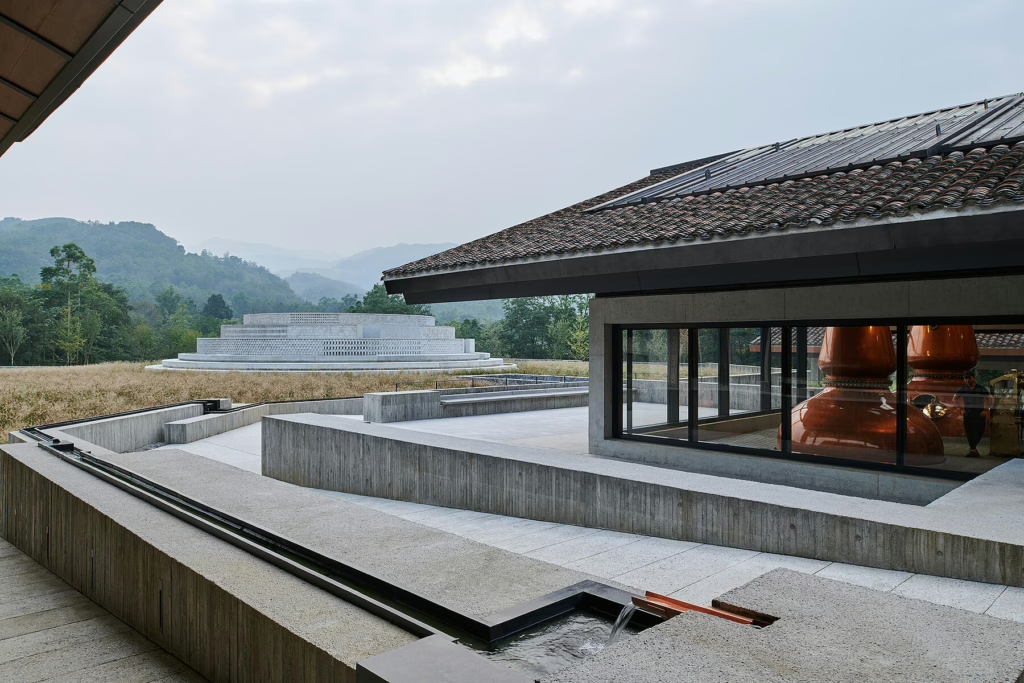
Behind the theatrical architecture, the production brief stayed resolutely orthodox. The distillery runs on malted barley – both European and Chinese – fermented with Emeishan spring water and distilled in two large Forsyths copper pot stills shipped from Scotland, under the guidance of master distiller Yang Tao working closely with veteran Scotch distillers within the Pernod Ricard group. The warehouses hold spirit in a mix of ex‑bourbon barrels, ex‑sherry casks and Chinese oak from the Changbai Mountains, the latter adding a distinctly local fingerprint to the maturation regime. By August 2021, the site had moved from commissioning to full operation, and in November that year Pernod Ricard formally inaugurated The Chuan as the first fully operational malt whisky distillery in China owned by an international spirits group.
From the outset, The Chuan was meant as more than a production facility. Pernod Ricard positioned it as a cultural icon for Sichuan, weaving in a permanent art programme (launched with an installation by artist Zhan Wang), a high‑spec visitor centre, and an immersive tour infrastructure designed to attract up to two million visitors over its first decade. The site blends tea‑house‑inspired lounges, cocktail rooms and VIP cellars with panoramic views of the Emei landscape, aiming to anchor whisky in a local ritual culture historically dominated by tea and baijiu rather than barley and oak.
The distillery’s first real statement came with the launch of 叠川 The Chuan Pure Malt Whisky, announced in late 2023 and rolled out more broadly in 2024. This inaugural release, built from that blend of European and Chinese barley and matured across bourbon, sherry and Chinese oak, crystallised the project’s founding idea: take classic Scottish know‑how, graft it onto Chinese terroir, and bottle something recognisably single malt yet unmistakably rooted in Emeishan. In just a few years, The Chuan has shifted from architectural curiosity to a fully-fledged player in the emerging Chinese whisky landscape, casting its layered, mountain‑and‑water identity as both a brand narrative and a genuine sense of place.
Goalong Distillery
Goalong’s story starts not in a boardroom, but behind a bar in Changsha. Before he became a distillery owner, Gao Kailang – better known internationally as Alan Gao – worked as a bartender, pouring Scotch, Irish and Japanese whiskies for curious drinkers in Hunan’s capital. Night after night he found the same gap on his back bar: he could reach for whiskies from all over the world, but not a single one came from China. That absence stuck with him. By 2013 he had left the bar to set up a first, small whisky project in Yueyang; a few years later, convinced that Hunan’s humid, forested hills and soft water had real potential, he moved the venture to Liuyang and began designing a modern distillery from the ground up.
The result is Goalong Distillery in the Two‑Oriented Industrial Park of Liuyang, officially founded in 2017 and built in stages at the foot of Dawei Mountain near the upper Liuyang River. The site sits in a natural basin, with mountains on both sides and an environment that is 99% forested; the distillery draws its water from the river’s source, where it filters through ancient shale into a naturally soft, slightly sweet supply ideal for brewing and distilling. Construction on the Liuyang complex began in 2018 with an ambitious master plan: multiple buildings for production, a research ‘whisky university’, visitor facilities and a series of warehouses that, once complete, should rank among the largest single‑malt bases in China.
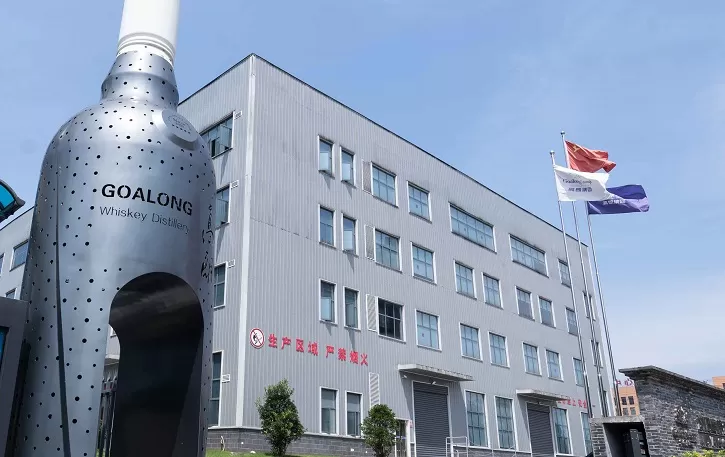
Goalong fired its first whisky stills before the new distillery even existed in its current form. In 2016 the team distilled ‘Laboratory The 1st’, the first Goalong single malt, at a smaller setup, using it as a proof of concept before committing to the Liuyang build. Once they secured the canyon site at the foot of Dawei Mountain, they installed a five‑tonne hybrid copper‑and‑stainless pot still with an upward‑tilted lyne arm and a large shell‑and‑tube condenser, heated by thermal oil. This configuration lets the team push temperatures beyond 140 °C in parts of the system, intensifying Maillard reactions1 and giving the new make that tell‑tale toasted bread note alongside sweet malt, rose and green‑apple aromatics. Eight 25‑tonne fermenters, running 96‑hour fermentations, feed this still, turning out spirit that then disappears into a remarkably eclectic cask inventory: ex‑bourbon, sherry, Mizunara and a range of ex‑wine casks from Port to Burgundy, plus a signature Chinese brandy cask shape that nods to the country’s grape‑brandy traditions.
From the outset, Goalong positioned itself as both a volume player and a stylistic experimenter. The Liuyang warehouses can currently hold 6,666 casks, divided into four zones that mimic Hunan’s distinct seasons – Spring, Summer, Autumn and Winter – so the team can study how microclimate affects maturation. Local coverage now reports daily output of around 10 tonnes of spirit, with roughly 70% destined for export and 2023 sales hitting RMB 1.12 billion (about €140 million), with a further growth forecast. At the same time, the distillery has invested heavily in energy recovery, wastewater treatment and CO₂ capture from fermentation, folding sustainability into the nuts and bolts of its process.
On the product side, Goalong released some of the first Chinese whiskies to reach international shelves, including the Goalong Single Malt ‘Laboratory’ bottlings, the ‘Vigorous’ single malt and a growing range of small‑batch and blended expressions aged around five years in ex‑bourbon and mixed casks. Parallel lines of Chinese brandy and green‑tea gin round out the portfolio, but whisky remains the flagship: a distinctly Chinese malt shaped by Liuyang’s soft water, lush forests and hot summers, rather than a simple imitation of Scottish conditions.
Today, the Liuyang complex continues to expand, with new still houses, additional four‑season cellars and a dedicated visitor and culture centre under construction. In barely a decade, Alan Gao took the idea he first formed as a young bartender – ‘Why isn’t there Chinese whisky?’ – and turned Goalong into one of the country’s largest and most visible malt whisky producers, exporting Hunan’s canyon air and forest‑filtered water in glass to bars and retailers far beyond China’s borders.
The Chuan Pure Malt Whisky (2023) Review
The Chuan Inaugural Release was unveiled in October 2023. This debut release blends spirit distilled on-site using both European and Chinese barley with a small fraction of imported Scotch to bridge the young Chinese whisky. The maturation was made in a cask trio: ex-bourbon barrels, ex-sherry casks and Chinese oak (Danling/Quercus mongolica or Changbai varieties). Before tasting, the bottling ABV feels a bit disappointing at just 40% ABV. Since the 2025 release, filled at 48.6%, does mention on the label it is unchill filtered, but this inaugural release does not, it’s safe to think that this 40% ABV release is chill filtered. There’s no mention about the colour being natural, so it might be coloured as well. This doesn’t seem available in Europe nor in the US as far as I know. It seems to have been released at RMB888, so about €100/£90/$128 at current exchange rates.
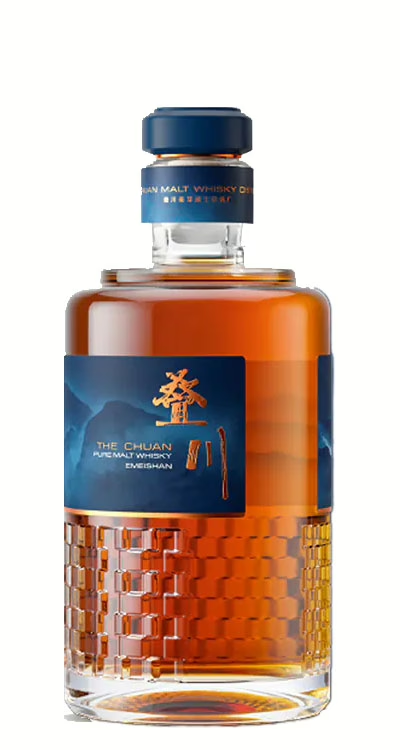
Colour:
Burnished.
Nose:
Neat: Syrupy marshmallow sweetness with fresh tangerine, jammy apricots and candied fruits balancing the floral-fruity cream. Teak wood, cedar, mint and subtle pear-ginger notes add woody freshness.
Palate:
Neat: A surprisingly creamy mouthfeel brings honey, nectarine, orange pith and digestive biscuits, with light pepper, dark chocolate and pine needles. Sherry richness layers crème brûlée, prunes and baking spice over biscuity grassiness.
Finish:
Medium length, with soft herbs, teak wood, orange zest and (no pun intended) mandarin peel warmth lingering gently.
Comments:
This Chuan Pure Malt delivers a genuinely pleasant surprise, defying low expectations around its modest 40% ABV and the wildcard of Chinese oak. Far from the dilution one might fear, it punches above its weight with surprising creaminess and textural depth – a velvety mouthfeel that coats rather than evaporates. Flavours unfold with balanced fruit and gentle spice, where the wood influence stays restrained and harmonious rather than dominant. No overt Chinese markers emerge to identify, but that’s no flaw; the result is simply a polished, flavourful dram that overachieves quietly and invites easy appreciation.
Rating: 6.5/10
Goalong 5-year-old Fine Quality (2022) Review
The first of our two Goalong whiskies is a 5-year-old named Fine Quality. It matured in bourbon casks, before being bottled at 40%, probably chill filtered and, judging by the colour, without the addition of E150 caramel. This expression is available in Europe for under €60 a bottle and £53 in the UK.
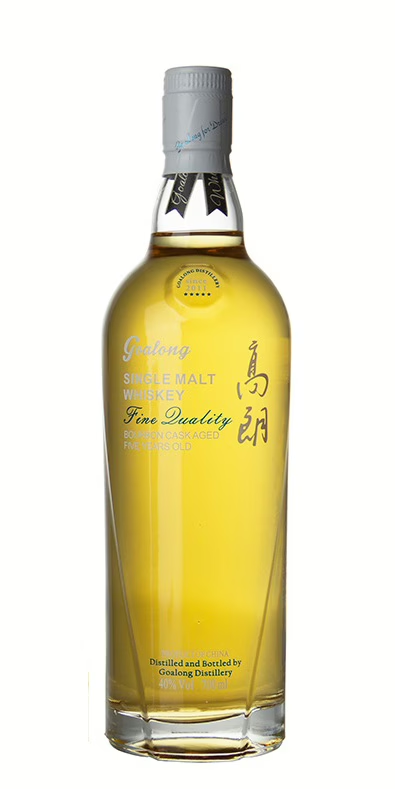
Colour:
White wine.
Nose:
Neat: Elegant fruit – honey, jam, raisins – with sweet malt, vanilla, oak and subtle floral hints. Gentle caramel, citrus peel and light spice emerge.
Palate:
Neat: The palate is quite sweet, with vanilla, honey, nectar and fresh fruit, layered with soft oak and spice. Toffee, cinnamon and mild nuttiness add warmth. The mouthfeel is thinner and lighter than the Chuan tasted just above.
Finish:
Medium with sweet spice, toasted oak and lingering vanilla, fading warmly.
Comments:
The nose offers inviting floral and orchard fruit notes that draw you in, but the palate proves disappointingly light and fleeting. At its modest ABV – compounded by likely chill filtration – the mouthfeel lacks density and persistence, leaving an impression of watery silk rather than the viscous texture you’d hope for in a more assertive whisky. Far from poor or insipid, it delivers competence without excitement – a solid daily dram, but unlikely to linger in memory.
Rating: 5/10
Goalong 5-year-old Small Batch (2022) Review
The second Goalong is a Small Batch matured for 5 years in Bourbon and Brandy casks. It was then bottled at 48% ABV, without chill filtration nor added colour. A bottle will cost you between €60 and €80 in Europe.
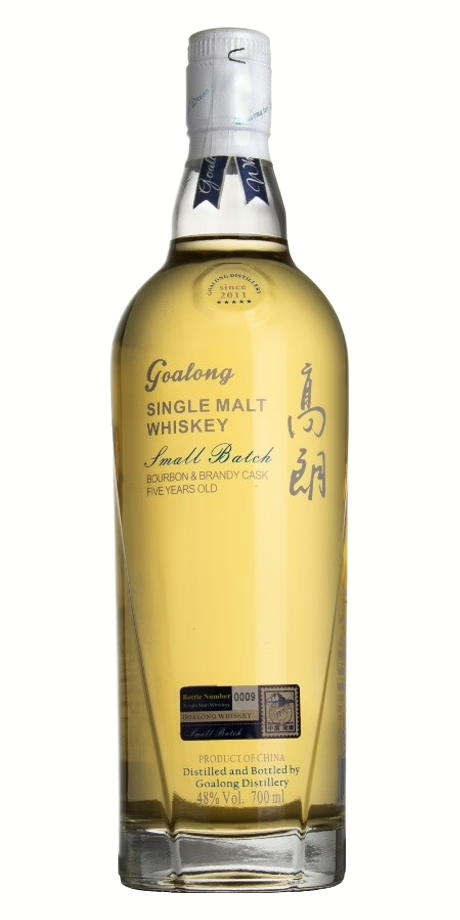
Colour:
White wine.
Nose:
Neat: Rich malt lead, with sweet cream, toffee, vanilla and honey wrapped around soft oak. Pear and light tropical notes (mango, pineapple, lychee) mingle with sultanas, dried apricots and a touch of straw. A gentle spice (cinnamon and cardamom) hovers in the background.
Palate:
Neat: Subtle and rounded, showing hazelnut and barley alongside sultanas and sweet cream. Vanilla, honey and soft toffee join a tropical fruit salad – lychee, mango, papaya – and a light peppery tingle. Hints of winey grapes, sherry richness and faint mocha echo the mixed-cask composition. The mouthfeel grandly benefits from the higher ABV and the lack of chill filtration, as it is creamy and syrupy.
Finish:
Medium, fruit forward with plenty of sultanas and soft stone/tropical fruits, finishing with gentle spice and toasted oak. A lingering note of sweet nectar, honey and a light hop‑like or grainy bitterness keep things interesting.
Comments:
This Goalong Small Batch marks a substantial leap forward from the entry level Fine Quality, transforming a competent dram into something genuinely compelling. The higher ABV delivers authoritative weight and presence, while the brandy cask influence weaves unexpected layers of dried apricot and toffee through both nose and palate, elevating intensity without sacrificing balance. Complexity blooms in waves – warm spice meets orchard fruit depth, with a mouthfeel that finally grips rather than glides. Quite impressive indeed; this one demands attention and rewards revisits.
Rating: 6/10
Thanks Arvid!
- The Maillard reaction is a chemical process where amino acids (from proteins) react with reducing sugars under heat, typically above 140 °C (280 °F), to produce hundreds of flavour compounds called melanoidins. These create the rich, savoury aromas and brown crusts in seared steaks, baked bread, grilled meats and toasted nuts – think roasting coffee or frying onions.
French chemist Louis-Camille Maillard first identified it in 1912 while studying protein synthesis. The reaction unfolds in stages: sugars’ carbonyl groups bind amino acids to form unstable glycosylamines, which rearrange (via Amadori reaction) into ketosamines, then fragment and polymerise into volatile aromatics, brown pigments and even potential antioxidants.
In whisky distillation – like Goalong’s high-temp still runs – it enhances toasted, bready notes in new make spirit by accelerating these interactions during prolonged heating. Unlike caramelisation (sugars alone), Maillard needs both proteins and sugars, peaking between 140 and 165 °C before pyrolysis (burning) dominates. ↩︎