There’s something especially moving about opening two cognacs like these side-by-side. Jean-Luc Pasquet’s Le Cognac d’André L.68/72 from Fins Bois and Le Cognac de Joël L.88/82 from Grande Champagne cru are not just old bottles to taste and compare — they are pieces of family history, shaped by growers, seasons, and places that still matter deeply in Cognac. One comes from the softer, more immediately charming register of Fins Bois, the other from the finesse and depth of Grande Champagne, and together they make a beautiful conversation in the glass.
They also arrive at a difficult moment for the category, especially for the latest one released this year. Cognac is going through a serious crisis, with exports falling, inventories piling up, and the industry forced to cut yields, uproot vines, and rethink its future under pressure from trade tensions and weaker demand in its key markets. That makes bottles like these feel even more precious: reminders of a slower, more human Cognac, made before the market became so strained.
Cognac’s Current Crisis
The Cognac industry is facing an unprecedented, highly critical situation driven by geopolitical trade disputes, a sharp post-COVID drop in global spirits consumption, and massive oversupply. Exporting about 98% of its production, the sector relies heavily on the United States and China—both of which have recently become hostile environments.
Following a dispute between the EU and China over electric vehicle tariffs, China imposed provisional anti-dumping duties on European brandy expected to become permanent at 35% to 39% by mid-2025. Simultaneously, the US implemented 10% tariffs in April 2025 under the Trump administration, with threats of further increases.
Plummeting Sales and Oversupply
These barriers have caused a dramatic drop in exports. In 2025, the industry shipped roughly 140 to 145 million bottles—a decline of over 30% across three years, reaching the lowest level since 2009. Consequently, producers are sitting on massive inventories. As of mid-2025, stock levels exceeded 10.7 years of rotation, far above the recognised equilibrium of 7 to 7.5 years.
Severe Mitigation Strategies (2024–2026)
To survive and manage this overstock, the industry—which supports around 70,000 jobs, 4,400 winegrowers, and 240 trading houses—has collaborated with its governing body, the BNIC, to implement drastic measures:
- Drastic Yield Reductions: The BNIC legally restricts production per hectare through the ‘Rendement Annuel Cognac’ (RAC – Cognac Annual Yield). This allowance has been aggressively slashed from 14.73 hectolitres of pure alcohol per hectare (hl AP/ha) in 2022, down to just 7.65 hl AP/ha for 2025/2026, preventing new eau-de-vie from flooding saturated ageing cellars.
- Strategic Vine Uprooting (‘Arrachage’): To physically shrink the production footprint, the industry aims to destroy approximately 3,500 hectares of vineyards. To incentivise this, the main winegrowers’ association (UGVC) announced it will borrow money to pay members €6,000 per uprooted hectare, supplementing €4,000 offered by the French government. A new 2025 rule also allows growers to uproot non-strategic parcels without losing their authorised quota on remaining vines; in fact, the base yield can be individually increased for those who participate.
- Crisis Distillation and Alternative Spirits: Producers are turning excess wine into industrial alcohol for perfumes, pharmaceuticals, or bioethanol. Additionally, the Charente region—often dubbed ‘Spirits Valley’—is pivoting excess infrastructure to produce currently popular spirits like gin, vodka, and French whisky.
- Employment and Financial Impacts: Major houses are cutting labour costs; in early 2025, Rémy Martin placed hundreds on short-time work, halting production lines one week per month. Regionally, the massive overstock has tied up enormous capital, with banks holding over €70 million in engaged stock loans. As a result, producers have frozen new investments (like equipment or cellar expansions), while banks have restructured loans to keep winegrowers afloat.
- Commercial Pivot (‘Monter en Gamme’): Long-term, major houses aim to ‘premiumise’ by focusing on older, rarer, and more expensive expressions (such as XO) to maintain profitability on lower volumes. Marketing efforts are also shifting away from the US and China toward emerging markets like India, Africa, Latin America, and Eastern Europe.
So, until this crisis in the back mirror, we have to help Cognac producers. I’m definitely doing my part, buying more Cognac than I used to!
Jean-Luc Pasquet Fins Bois Lot 68/72 Le Cognac d’André (2023) Review
‘Le Cognac d’André L.68/72’ is sourced from the vineyards of André Porchet, located in the Fins Bois cru at Asnières-la-Giraud. André is the 6th generation of a family that has been continuously cultivating vines on this land since 1680, surviving even the catastrophic phylloxera crisis without ever interrupting production. A reserved and traditional winegrower, André, alongside his wife Mireille, successfully grew their estate from 10 hectares in 1975 to around 40 hectares today, which have now been passed on to their children (the 7th generation), Gaëlle and Yann. This specific, highly limited lot (a single cask yielding only 738 bottles) was blended in the 1980s from André’s earliest years in the vineyard (vintages 1968 and 1972) and was selected and bottled by the independent, organic-pioneering Cognac house Jean-Luc Pasquet. They bottled it at cask strength (54.3% ABV), without chill filtration nor additives. A 50 cl bottle costs about £180 in the UK, and is usually close to €300 in France (even though it was initially closer to €230), but it’s on offer right now at that old price at La Cognathèque at the time of publishing.
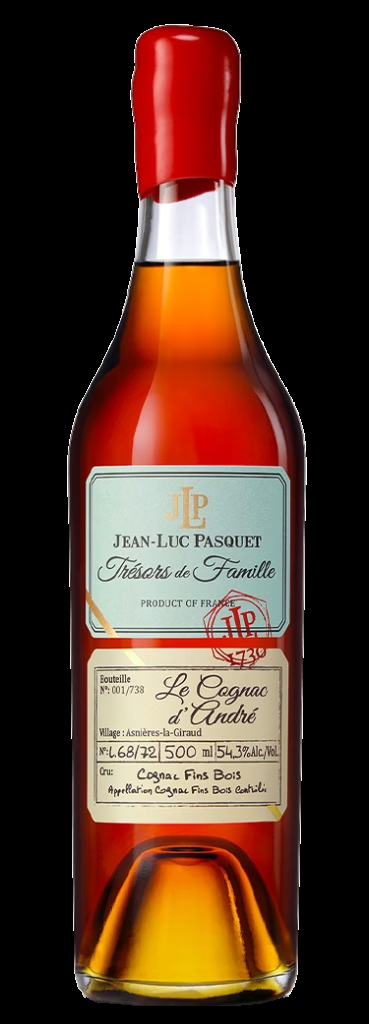
Colour:
Clay.
Nose:
Neat: A very expressive nose of passion fruit, brioche and cinnamon leads the way, with honey and spice giving it lift. Beneath that sit ripe plum, candied banana, toasted oak and a light rancio, plus a subtle floral, old-wood character. A little vanilla and orange peel round out the profile, keeping it rich but not heavy.
With water: Sweet and buttery Vendean brioche appears, sparkled with vanilla powder, and some candied fruits. More vanilla sweetness also comes with reduction, as custard-filled pastry shines. The oak and rancio take a back seat, as they’re almost not noticeable anymore.
Palate:
Neat: Sweet and polished on the palate, showing passion fruit, flambéed banana, honey and plum jam up front. The fruit turns more layered with cinnamon, gentle spice and a pastry-like sweetness, while the oak remains neatly integrated, even though it gets more present than on the nose. There’s a touch of rancio, a little citrus peel and a soft earthy depth .
With water: Contrary to the nose, the wood takes front stage, but leaves place to salted liquorice and liquorice root, panettone and orange peel.
Finish:
Long and composed, fading on plum, honey, warm spice and a dry whisper of oak. The final impression is fruity, lightly tannic and faintly nutty, with rancio lingering in the background.
Comments:
A stunning Fins Bois, showing a lovely exotic development over its more than five decades in wood. Easily drinkable despite its higher than usual ABV for a Cognac (especially when you’re used to drinking cask strength spirits!). It’s a bit expensive, but really worth the money.
Rating: 8/10
Jean-Luc Pasquet Grande Champagne L. 88/82 Le Cognac de Joël (2026) Review
‘Le Cognac de Joël L.88/82’ pays tribute to Joël Rateau, a third-generation winegrower and distiller located in the Grande Champagne cru. Joël’s family started as tenant farmers in Malaville before purchasing their own estate, the Maine Frugier in Nonaville, in 1968, where Joël officially set up as a young viticulturist in 1980. Joël was known for his inventive and humorous approach to his craft; famously, to avoid spending his newlywed nights away from his wife monitoring the still, he engineered a system using mechanical alarm clocks to automate parts of the distillation process. Today, his 25-hectare vineyard is managed by his son, Cédric. This specific release is a blend of Grande Champagne eaux-de-vie distilled between 1982 and 1988 (100% Ugni Blanc), bottled at cask strength (49.2% ABV) by Jean-Luc Pasquet in a limited run of just 348 50cl bottles. A bottle will set you up €150 on Pasquet’s website or at Cognac-Expert*.
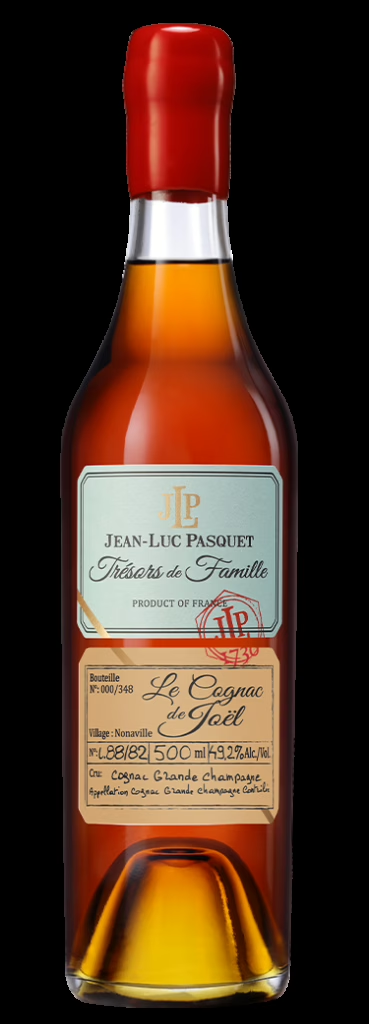
Colour:
Cider.
Nose:
Neat: Expressive and mature, with exotic fruits, dried apricots and candied orange peel up front. It also shows subtle oak, vanilla and tobacco, plus a richer layer of plum, brioche and cigar-box character. The overall impression is generous and fruit-led, with a polished old-cognac profile.
Palate:
Neat: The palate is ample and silky, combining exotic fruit sweetness with dried stone fruit and orange peel. Beneath that, there is integrated oak, vanilla and tobacco, along with a soft rancio-like depth and pastry notes. The wood influence is well balanced, present but not overwhelming. There is also what feels like, for just a moment, an unusual salinity, giving this Cognac de Joël something unexpected and unique.
Finish:
The finish is long, leaving dried fruit, orange zest, gentle spice and a lingering tobacco-oak thread. It closes with a warm, rounded sweetness.
Comments:
Amy told me I would love it when it was released, so I immediately ordered a bottle, especially after reading their tasting notes. And she knows me well, as I do love this Cognac de Joël.
Rating: 8/10
* Want to buy one of these cognacs? You can have 15% off your next order onCognac-Expert, even if you’re already a customer there, using the code COLDORAK. It will also help support the blog as I receive a small commission on this order if you’re an existing customer, or for 18 months if you’re a new customer!
Of course, despite that, you can be sure my reviews will always be honest ones, where I express my own and true opinion.