It’s been a long time we had a Linkwood on More Drams, so let’s taste three of them, with a Linkwood 1979 from Vintage Malt and two 30-year-old from Signatory Vintage and the SMWS. And since, apart from a short intro a long time ago, we didn’t properly talk about Linkwood distillery’s history, let’s have an in-depth look at the distillery’s history.
Linkwood Distillery History
Linkwood Distillery is one of those quietly pivotal Speysiders whose name you see more often on the side of a bottle than on a visitor‑centre map. It sits on the outskirts of Elgin, just off the A96, in a part of Moray where the landscape seems built for whisky: soft hills, barley fields and the faint hum of distant stills. Its story begins not with a big corporate plan but with a local factor, Peter Brown, who owned the Linkwood Estate and saw an opportunity to turn his own barley into something more valuable than feed.
Brown founded the distillery in 1821, at a time when legal distilling was still a relatively new and tightly controlled business. He built a modest plant with two stills – essentially one wash and one spirit still – and waited until the Excise Act of 1823 made licensing more accessible before firing them up in earnest. Production officially began in 1825, with a capacity of just a few thousand litres a year, and Brown ran the operation himself for more than fifty years, handing it down to his son William when he died in 1868.
By the 1870s, that original little distillery had become a bottleneck. William Brown, working with architect Methven, tore it down and replaced it with a much larger, more modern plant on the same site between 1872 and 1873. This new Linkwood had a capacity of around 227,000 litres per year, a serious step up, and it was further expanded later to about 454,000 litres as demand for Speyside malt grew. The Brown family continued to control the site through the creation of the Linkwood‑Glenlivet company in 1898, which floated on the stock exchange and cemented the distillery’s place in the expanding whisky economy.
The 20th century brought both upheaval and continuity. During the First World War, like many distilleries, Linkwood was pressed into service for other purposes – turning out industrial alcohol rather than whisky – but it returned to malt production when hostilities ended. In 1933, after more than a century in Brown hands, the distillery was sold to Scottish Malt Distillers Ltd., a move that would eventually bring it into the Diageo fold. Under SMD and later Diageo, Linkwood became a workhorse for blends such as Johnnie Walker and White Horse, its light, grassy, floral spirit prized for its ability to add freshness without overwhelming the mix.
Production continued through the mid‑20th century, with the distillery undergoing several refurbishments and capacity upgrades. In 1971 a second still house was added, effectively doubling output and giving Linkwood one of the more unusual layouts in Scotland: two still houses, with the original building falling silent in 1996, while the newer one carried on distilling. The distillery draws its water from the Milbules spring, a local source that feeds into the light, spring‑meadow‑like character of the new make – cut grass, apple blossom and a hint of peach that blenders have long valued.
Linkwood’s story gains a second, almost architectural layer once you factor in Linkwood A and Linkwood B – two still houses that, between them, stretch the distillery’s life from the 1820s right up to today. The original site, what later came to be called Linkwood A, is the one Peter Brown built in 1821 and that William Brown rebuilt in the early 1870s: a single‑still‑house complex that carried the name through the Brown family era and into the DCL and Diageo years.
As I said above, in 1971, with demand for Speyside malt surging, Scottish Malt Distillers added a second, more modern facility right alongside it, christened Linkwood B. From then on, both still houses ran in parallel, sharing the same water source and roughly the same light, grassy Speyside style, and together they pushed Linkwood’s annual capacity to around 2.5 million litres. For a while, ‘Linkwood’ effectively meant A + B operating as one distillery, with spirits from both houses often blended together before filling into casks.
By the mid‑ 1980s, however, the balance shifted. In 1985 the original Linkwood A site ceased regular production; its stills falling silent, while Linkwood B took over the bulk of the distillation. For a few years the old house was mothballed, then briefly revived for occasional experimental runs in the 1990s, as Diageo used the historic stills to test different regimes or small‑batch styles. These runs are why you occasionally see independent bottlings explicitly labelled ‘Linkwood A’ or ‘Linkwood A‑series’—a tiny, almost ghostly continuation of the original plant’s character.
Eventually, the old buildings were demolished around 2012, but the story didn’t end there. The original stills were moved into Linkwood B, where they now sit alongside the newer ones, and the spirit from all six stills is still treated as one Linkwood house style. Today, the ‘A’ designation lives on mainly in memory and on cask labels, while the physical site is essentially one large, modernised still house – Linkwood B – carrying forward the light, floral, apple‑blossom‑heavy character that has made the name so prized in blends and, more recently, in a scattering of sought‑after single‑malt releases.
Official single‑malt bottlings have always been sparse. For many years, Linkwood was best known for Diageo’s Flora & Fauna 12‑year‑old and the Rare Malts series, with most of the rest of the spirit quietly absorbed into blends or sold on to other companies. Independent bottlers such as Gordon & MacPhail, Duncan Taylor and Douglas Laing have kept the name visible, often highlighting the distillery’s freshness and delicate texture. Today, Linkwood remains an active, industrial‑scale site with no visitor centre, but its history is written less in tours and tastings and more in the sheer volume of blended Scotch that has carried its light Speyside character around the world for nearly two centuries.
Linkwood 1979 The Cooper’s Choice (1995) Review
We start with a Linkwood 1979, bottled in 1995 by The Vintage Malt Whisky Co. in their ‘The Cooper’s Choice’ series. Featuring a 15-year-old age statement, it was bottled at 43% ABV for Importato da VA.MA. Distribuzone Bergamo Market for the Italian market.
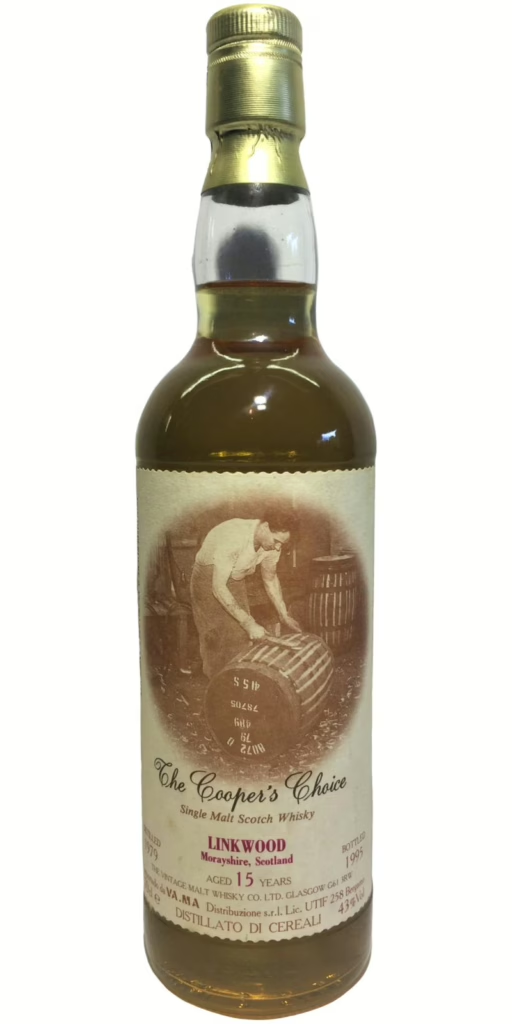
Colour:
Jonquille.
Nose:
Neat: The nose shows great fruitiness and freshness after 30 years in glass, with ripe apricots, mangoes and oranges, but also Corinth raisins. Light whiffs of old oak and smoke, and some light as well leafy notes of ivy. After some aeration, a little fudge and crème brûlée, mead and pollen.
Palate:
Neat: The palate shows some alcohol heat despite the low ABV and, again, the 30 years in glass. It starts slightly fruity, with some leafy and metallic acidity that might be a sign of OBE (old bottle effect). Dry wood and caramel extract show more wood influence, while tar and soot hint at the use of peat to dry the barley. There is a noticeable bitterness as well, reminding of a chicory gratin.
Finish:
The bitterness lingers for a medium-short length, with a light and artificial sweetness (aspartame) and hints of fruits, then suddenly drops.
Comments:
If the nose is absolutely stunning, the palate falls a little short, with a distinct chicory note that doesn’t carry through to a lingering finish. Even so, this remains a lovely dram – perfect for nosing and sipping slowly, as the aromas alone are worth revisiting for hours.
Rating: 7/10
Linkwood 1989 SMWS 39,198 Understated Opulence (2021) Review
Next, we have a Linkwood distilled on the 16th of October 1989. After 27 years in an ex-bourbon hogshead, this whisky was transferred into a 2nd fill toasted oak hogshead for the remainder of its maturation. This toasted cask was previously used to mature Society cask 35.181 (a Glen Moray). Having reached 30 years of age, it was bottled by the Scotch Malt Whisky Society in 2021, with an outturn of 197 bottles filled at 49.2% ABV. As usual, they were non-chill filtered and with natural colour. There is just one single bottle left to buy at the SMWS Switzerland, for CHF 350.
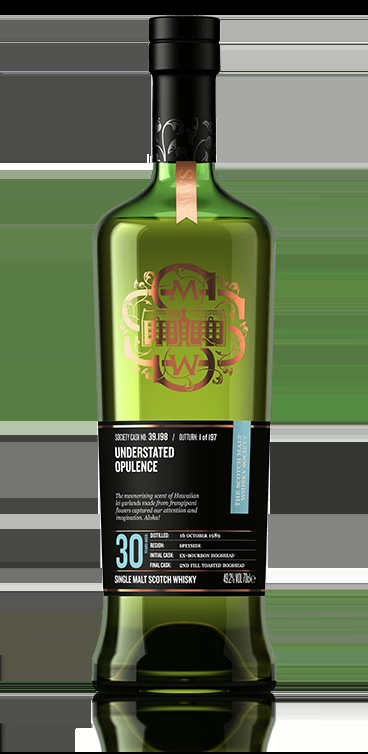
Colour:
Amontillado.
Nose:
Neat: The nose opens with beeswax, toffee and a subtle floral scent that might feel ever so slightly soapy. Soft vanilla and caramel mingle with cocoa nibs and pine needles, while notes of candied orange peel and smashed hazelnuts add a rich, textured depth. There is a faint hint of sweet cough syrup and heather as well.
Palate:
Neat: On the palate, the whisky feels like a vintage leather pipe pouch – rich, rustic and well‑worn – holding notes of sweet tobacco and dried fruits. It is fairly dry and spicy, with black pepper, cinnamon and lemon zest cutting through the sweetness of caramel and vanilla. The texture is silky and mouth‑coating, carrying flavours of virgin olive oil and light roses, but the cask used for the finish brought tannins makes the alcohol feel slightly spirited for 30 years of age.
Finish:
The finish is medium in length and leans towards the dry side, with lingering notes of vanilla, black pepper and a touch of woody bitterness. The floral and herbal elements persist – heather, malt and a whisper of cough syrup – leaving a slightly astringent aftertaste.
Comments:
The nose and palate are both very good, yet each carries subtle off‑notes or slight disappointments. The nose, while floral and inviting, can reveal a faint soapy character for the attentive taster. On the palate, the whisky feels younger than its age statement suggests, with an overly spirited alcohol presence – likely inherited from the finishing cask, even though it was a second fill. One can’t help but wonder why the Scotch Malt Whisky Society opted for this finish after the Linkwood had already spent 27 years in a hogshead. Was the spirit too fiery, prompting a second‑fill cask to tame it? Or was it lacking a bit of oomph, and the finish was intended to inject a little extra kick? In my case, another dram of this Linkwood – still very good overall – would be welcome to ponder that metaphorical question further.
Rating: 7/10
Linkwood 1995 Signatory Vintage (2025) Review
We close this session with a Linkwood distilled around the same time the first whisky of the evening was bottled. Distilled on 5 June 1995, it spent 30 years in what is labelled as a first‑fill PX hogshead (cask #20), before Signatory Vintage released it on 13 August 2025 as part of their The Awakening series. With only 344 bottles at 51.1% ABV, the cask type may, in fact, have been a finishing vessel; otherwise the angel’s share over three decades would have been remarkably low. This Linkwood is now sold out at retail, but bottles may still surface on the secondary market.
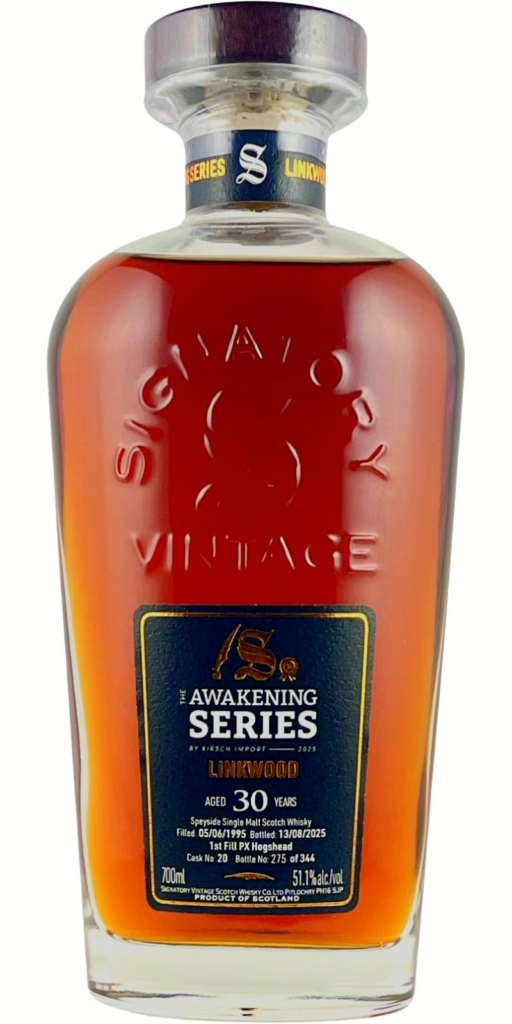
Colour:
Old oak.
Nose:
Neat: The nose opens with opulent notes of dark dried fruit – raisins, figs, dates – alongside toffee and caramel, with a subtle polish of mahogany wood threading through. Gentle spice notes of cinnamon and nutmeg emerge, joined by leather and fine tobacco nuances that add additional depth and sophistication. The overall impression is rich yet balanced, beeswax and warm honey framing the darker fruit tones without overwhelming them.
With water: A splash of water softens the cask strength‘’’s intensity while amplifying the richness of the dark dried fruits and honey on the nose, allowing the leather and tobacco nuances to emerge more clearly.
Palate:
Neat: The palate is full‑bodied, silky and exceptionally complex, delivering intense sherry sweetness reminiscent of dark dried fruits – raisins and figs – underscored by rich chocolate and plum compote. Refined oak and walnut notes provide structure, with a whisper of nutmeg and black pepper, adding spice that cuts through the sweetness.
With water: The texture becomes even creamier, with the sherry sweetness and chocolate notes gaining roundness, while the oak and spice integrate more smoothly.
Finish:
The finish is long and warming, with lingering cocoa, sweet sherry, dried fruits and gentle spice in the fade. A faint waxiness and soft oak bitterness persist.
Comments:
A lovely PX‑influenced maturation for this old Linkwood, striking a fine balance between richness, sweetness and wood, with just enough spice to keep the sweetness in check. A few drops of water help the spirit and oak integrate even more harmoniously, softening the spices to an ideal level. A stunning example of an old Linkwood, full of depth and elegance.