Cardhu is a popular Speyside distillery, best known for its 12-year-old core expression. Since this is our first time covering the distillery, we’ll start with a brief introduction before comparing a Cardhu 12-year-old bottling from the 1970s with one from the 2020s.
Cardhu Distillery
Cardhu is a Speyside distillery with a story that is closely tied to women, family ownership, and a soft, approachable house style. It began as an illicit farm distillery in the early 1800s, was licensed in 1824, and later became an important component in Johnnie Walker, while also standing on its own as one of Diageo’s best-known single malts.
Cardhu’s roots go back to John and Helen Cumming, who began distilling on Cardow farm before the business became legal. Helen Cumming has a special place in whisky history because she is often credited with helping keep the illicit operation running and later shaping the distillery’s early success. After John’s death, the family continued to run the distillery, and Elizabeth Cumming later took over and expanded it. The name Cardhu comes from the Gaelic for ‘black rock’, and the distillery sits in Knockando, near Archiestown in Moray, in the heart of Speyside.
Cardhu is known for a light, fruity, honeyed character. That style is supported by a fairly large production setup for a Speyside distillery, with six stills, long fermentation, and maturation that often leans on ex-bourbon casks. The result is a whisky that is easy to drink and a clear Speyside identity. Cardhu became especially important after John Walker & Sons bought the distillery in 1893. It has long served as a key Speyside malt in Johnnie Walker, which is one reason the distillery has such a strong commercial profile even beyond its single malt bottlings.
Today, Cardhu is still seen as a classic soft Speyside malt, but it also has a bit of historical intrigue because of the early-2000s ‘pure malt’ controversy, when Diageo briefly moved away from the single malt format before restoring it after backlash. That episode only reinforced Cardhu’s place as a recognisable and trusted name in Scotch whisky.
You could ask why it would become ‘more trusted’ after such a controversy? Because the backlash made Cardhu more visible, not less. The 2003 ‘pure malt’ episode put the brand at the centre of a wider debate about what a single malt is, and when Diageo backed down and restored the single malt, Cardhu ended up looking like a distillery whose name mattered enough for people to fight over it. It also reinforced consumer recognition. The controversy showed that drinkers were paying close attention to Cardhu’s label, style, and identity, and the fact that the brand was restored after criticism made it clear that it had a loyal audience and a strong enough reputation to survive the mistake.
Now, let’s see if that reputation seems deserved.
Cardhu 12-Year-Old (1970s) Review
This specific Cardhu 12-Year-Old is a rare, vintage official bottling (OB) produced in the 1970s. During this era, Cardhu was highly prized by blenders (serving as the heart of Johnnie Walker) and was one of the few single malts marketed globally by Distillers Company Limited (now Diageo). This particular expression was bottled at 43% ABV in a 75cl format, specifically for the Italian market, imported by the Genoa-based company Wax & Vitale. The packaging is distinct from modern Cardhu, as 1970s bottles were tall, often featuring a rectangle label, a cork stopper (though this one isn’t), and varying shades of natural colour, depending on the specific batch, as heavy caramel colouring was less standardised. Due to its age and historical significance, it is a highly collectible “dusty”. It cannot be found in standard retail shops; rather, it appears at specialised whisky auctions or vintage spirits retailers. Today, depending on the fill level and condition of the label, it generally commands auction prices ranging from €160 to €325 (roughly $175 to $350).
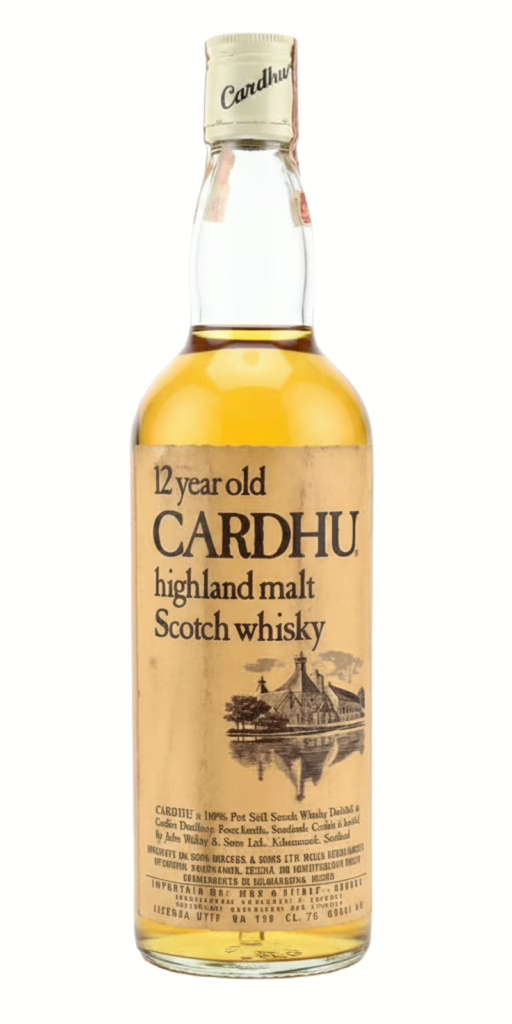
Colour:
Deep gold.
Nose:
Neat: The nose is remarkably fresh, gentle, and complex, immediately distinguishing itself from modern Cardhu. It opens with a vibrant burst of tropical and green fruits, specifically green banana, pineapple, and grapefruit. Beneath the fruit lies a rich, sweet aroma of crème pâtissière (vanilla custard), honey, and marzipan, and some herbal notes. A distinct, old-school industrial note—reminiscent of fresh book ink or faint paint thinner—adds an intriguing layer alongside a very delicate wisp of wood ash and light smoke.
Palate:
Neat: The palate is characterised by a very oily, waxy texture that coats the mouth completely—a hallmark of many 1970s Speyside whiskies. The flavour profile is highly distillate-driven, showing very low wood impact. It arrives with fresh acidity and light orchard fruits before sweetening considerably mid-palate. Concentrated flavours of sweet grains, honey, and orange zest mingle with rich almonds and roasted nuts.
Finish:
sThe finish is long, complex, and teasing. It starts with lingering sweet fruit and honey before transitioning into a gentle, drying sensation characterized by hints of earthy peat smoke, roasted almonds, and a final touch of waxy grapefruit peel.
Comments:
This 1970s Cardhu 12-year-old is a very good Speyside whisky, showing the characteristics of a Speysider of the past: fruits, sweetness, and a light touch of peat, adding a nice complexity. At just 43%, it shows a very oily mouthfeel and character, really nice.
Rating: 7/10
Cardhu 12-Year-Old (2020s) Review
The modern-day Cardhu 12-Year-Old is a core expression from Diageo, serving as the flagship release for the distillery. Situated in Speyside, Cardhu is famous for being the spiritual home and key malt component of the Johnnie Walker blended whiskies. Marketed heavily towards southern Europe (particularly Spain and France), the modern 12-year-old is designed to be an incredibly soft, approachable, and easy-drinking single malt.
It is typically matured in a mix of ex-bourbon and ex-sherry oak casks and is bottled at a highly accessible 40% ABV (though some specific international markets occasionally see 43% variants). Consistent with most high-volume, entry-level Diageo single malts, it is chill-filtered to ensure clarity and contains artificial caramel colouring (E150a) to maintain a consistent golden-amber hue across all batches. It is widely available and budget-friendly. In the UK, the standard 70cl bottle generally retails for £35 to £45. In Europe, it sits between €30 and €40, while in the US, a 750ml bottle usually costs between $40 and $55.
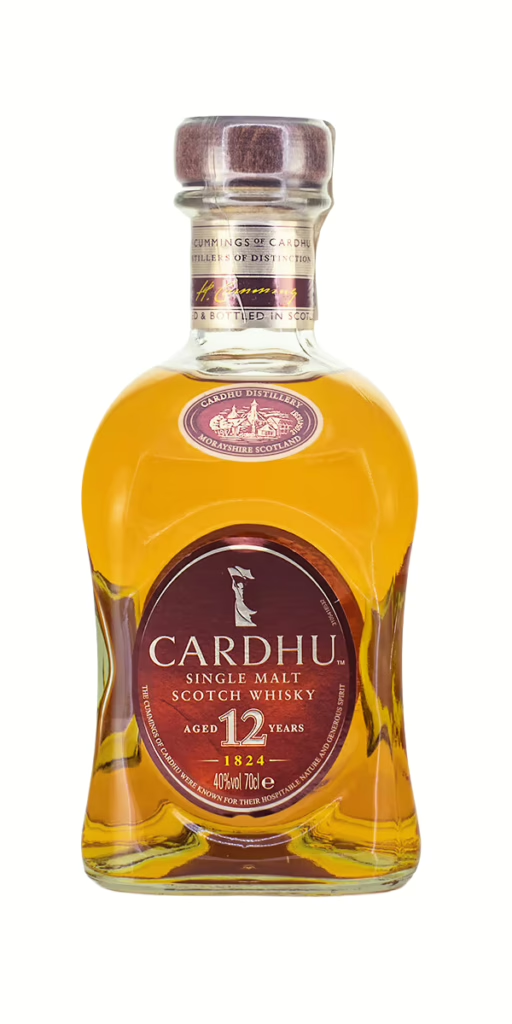
Colour:
Deep gold.
Nose:
Neat: The nose is exceedingly soft, sweet, and floral—a quintessential light Speyside profile. It leads with gentle aromas of honey, vanilla, and sweet cereal malt. This sweetness is backed by a bright, fresh fruitiness reminiscent of ripe pears, green apples, and apricots. There is a very faint, almost undetectable whisper of smoke or dry heather in the background.
Palate:
Neat: The palate is light-bodied, with a very soft, silky, and unchallenging texture. It arrives with an immediate, pleasant sweetness of toffee apples, caramel, and honey. As it develops, notes of orchard fruit—pear and apples—emerge alongside a gentle, sweet maltiness (often likened to oatmeal biscuits). Towards the back of the palate, a mild, warming spice of cinnamon, pepper and dry oak provides a nice counterpoint to the fruit. But everything stays quite mild.
Finish:
The finish is relatively short, clean, and quite dry. The sweet, honeyed fruit fades quickly, leaving an aftertaste of dry oak, a dash of black pepper, and a very soft, lingering note of sweet smoke and malt.
Comments:
Well, there’s nothing unexpected in this Cardhu 12-year-old: a gentle Speysider showing no surprise, nothing excessive. It’s nice and well made, but ruined by the low ABV and the chill filtration, which tame everything. A slightly boring easy sipper, that could have been much more with some additional power.